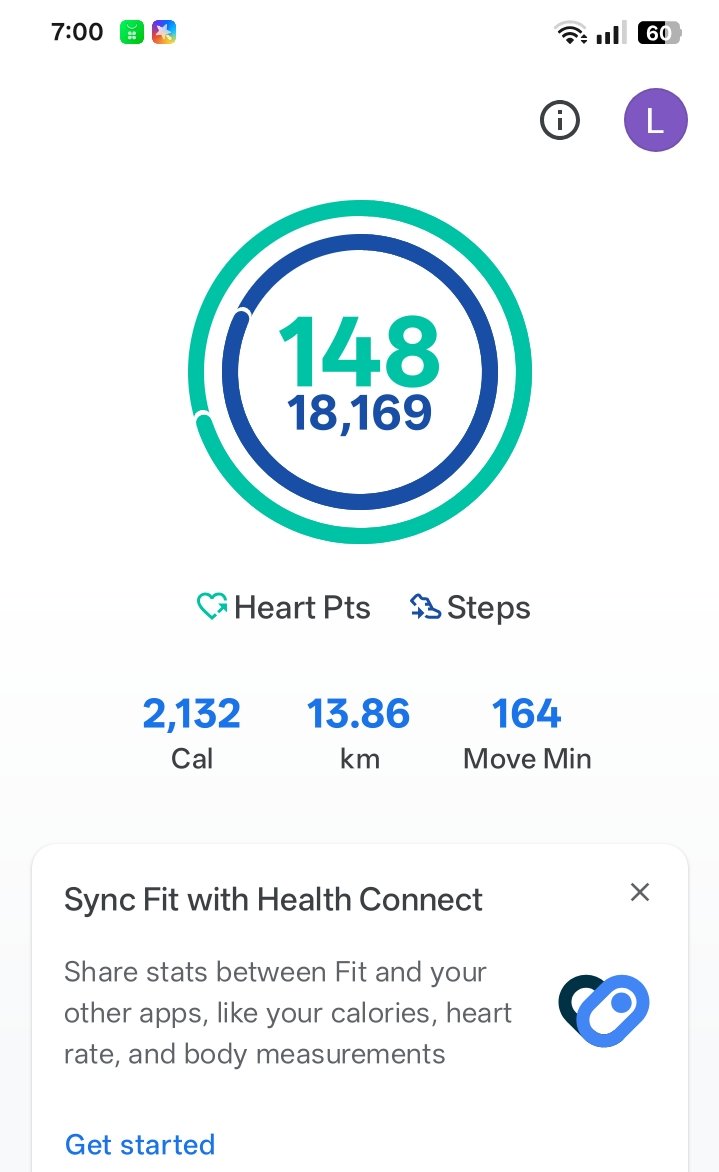
For the past 18 months, I have averaged around 12,000 steps a day.
When I started, I weighed about 102 kg (225 lbs) and was 179 cm tall. Today, my weight generally sits around 80 kg (176 lbs).
That means I have lost roughly 22 kg, or almost 49 pounds.
But if you asked me what the most significant benefit of walking 12,000 steps a day has been, I wouldn’t say the number on the scale.
I sleep better. I can climb stairs without getting out of breath. I feel lighter. Everyday movement is easier.
And perhaps the best test of all is my son.
When he was four years old, carrying him for more than a couple of minutes felt exhausting. Now that he is eight and considerably heavier, I can carry him without feeling as if I am going to die.
Walking didn’t magically resolve everything. In fact, my experience also taught me one important lesson about what walking cannot do on its own.
I started losing muscle.
That forced me to rethink what I was doing, increase my protein intake, and add resistance training.
So if you’re wondering what happens when you walk 12,000 steps a day, especially if you’re trying to lose weight and improve your health as you grow older, here’s what my experience has taught me.
Is Walking 12,000 Steps a Day Good for You?
Yes. Walking 12,000 steps a day can be an excellent way to increase your daily physical activity, burn more calories, improve cardiovascular fitness, and support weight management.
For me, it became the foundation for losing more than 20 kg.
But there’s an important distinction:
Walking can be a fantastic foundation for fitness. It isn’t necessarily a complete fitness program.
I eventually learned that the hard way.
My current approach is much closer to
Walking + adequate protein + resistance training + sensible nutrition.
That combination makes far more sense to me now than simply trying to accumulate as many steps as possible.
My Starting Point: 102 kg and 12,000 Steps a Day
At 179 cm and approximately 102 kg, I knew I needed to make changes.
But I didn’t start by trying to become a runner or following an extreme exercise program.
I walked.
And then I kept walking.
Over time, I settled into averaging roughly 12,000 steps every day.
Twelve thousand steps isn’t a magical number. Depending on your stride length, that may translate to roughly 8–10 kilometers of walking, though the actual distance varies considerably from person to person.
What mattered more to me was consistency.
I didn’t need a gym to get my steps.
I didn’t need complicated equipment.
I simply needed to move.
Day after day, those ordinary walks started adding up.
How Much Weight Can You Lose Walking 12,000 Steps a Day?
This is probably one of the first questions people have.
Unfortunately, there isn’t a universal answer.
Your calorie expenditure depends on factors including your body weight, walking speed, distance, terrain, age, fitness level, and other individual characteristics.
And weight loss ultimately depends on your overall energy balance, not simply your step count.
My experience illustrates that pretty well.
I started at approximately:
102 kg
After consistently walking around 12,000 steps per day, my weight eventually fell to approximately:
82 kg
That’s about 20 kg lost.
But I don’t want anyone reading this to conclude that walking 12,000 steps automatically causes a 20 kg weight loss.
It doesn’t.
Walking was a major part of my lifestyle change, but what I ate mattered too.
And eventually something happened that will be familiar to many people trying to lose weight.
The scale stopped moving.
I Eventually Hit a Weight-Loss Plateau
Going from 102 kg to around 82 kg was a huge change.
But eventually I reached a plateau.
This makes sense.
A lighter body generally requires less energy to move around than a heavier one. Your energy requirements can also change as you lose weight, while hunger, food intake, activity, and other factors can shift over time.
The habits that produced weight loss earlier therefore don’t necessarily continue producing weight loss indefinitely.
I had reached the point where simply continuing my usual routine wasn’t moving the scale very much.
So I experimented with another strategy:
Intermittent fasting.
I started fasting three days per week.
Combined with my walking and overall eating habits, my weight eventually dropped further from around 82 kg to approximately 78 kg.
Later, I reduced how often I fasted.
My weight came back up slightly and now tends to settle at around 80 kg, sometimes moving approximately 2 kg in either direction before coming back down.
And I’m actually comfortable with that.
The Scale Doesn’t Need to Go Down Forever
This may be one of the most important things my 18-month experiment has taught me.
At first, success meant:
Make the scale go down.
102 kg became 95.
95 became 90.
90 became 85.
Eventually I reached the high 70s.
But you cannot use that definition of success forever.
At 179 cm and around 80 kg, I’m now much more interested in body composition, strength, energy and maintaining healthy habits than endlessly trying to make myself lighter.
That became particularly obvious when I noticed something concerning.
I wasn’t only losing fat.
I appeared to be losing muscle too.
The Mistake I Made: I Walked, but I Wasn’t Training My Muscles
Walking made me much more active.
But walking and resistance training aren’t the same thing.
I also wasn’t eating enough protein.
When you’re losing a substantial amount of body weight, preserving lean mass becomes important. Resistance exercise gives your muscles a reason to remain strong, while adequate dietary protein supports muscle maintenance and recovery.
I had concentrated heavily on
steps + weight loss + eating less.
What I hadn’t paid enough attention to was:
strength + muscle + protein.
Eventually, I could see and feel the difference.
I was lighter, but I didn’t want being lighter to come at the expense of becoming weaker.
So I changed my approach.
I Started Eating More Protein and Training My Muscles
This was another turning point.
Instead of focusing exclusively on calories and steps, I started paying much more attention to protein and resistance exercise.
The difference in how I felt was significant.
I started feeling stronger again.
My muscles started recovering.
And my goal changed.
I don’t just want to be a smaller version of the person who weighed 102 kg.
I want to be leaner, stronger and physically capable.
That’s an important distinction, especially as we get older.
Walking remains a huge part of my routine, but I no longer think walking alone is enough for everything I want from my health.
Walking 12,000 Steps a Day Changed Things the Scale Couldn’t Measure
Losing more than 20 kg is obviously noticeable.
But some of the improvements I value most don’t show up when I step on a scale.
I Can Climb Stairs Without Losing My Breath
This sounds like a small thing until you’ve experienced the opposite.
At my heavier weight, everyday physical activities required noticeably more effort.
Now I can climb stairs without feeling seriously out of breath.
That change tells me something the bathroom scale cannot:
My body is more capable than it used to be.
My Sleep Improved
Another difference I noticed after becoming consistently active was better sleep.
Regular physical activity is associated with better sleep, although walking isn’t the only factor that affects sleep quality.
For me, however, the difference has been noticeable.
After moving throughout the day, my body actually feels ready to rest.
I Feel Lighter
This is difficult to quantify, but perhaps easier to understand if you’ve lost a substantial amount of weight.
Imagine carrying a 20+ kg weight around with you all day.
Then imagine putting it down.
That is approximately how much body weight I’ve lost.
Walking, climbing stairs and simply moving around now require less effort.
And Then There’s My Son
This may be my favorite measure of progress.
When my son was four, I could barely carry him for more than a couple of minutes without feeling completely exhausted.
He’s eight now.
He’s obviously much heavier than he was at four.
Yet I can carry him much more comfortably today.
Think about that for a moment.
My son got heavier while carrying him got easier.
No number on a scale captures that improvement.
For me, that’s what fitness is ultimately supposed to accomplish.
I want my body to let me participate in my life.
Is 12,000 Steps Better Than 10,000?
There is nothing magical about either number.
The famous 10,000-step target is useful because it’s simple and memorable, but you don’t suddenly become healthy when your pedometer changes from 9,999 to 10,000.
Research on daily steps generally suggests that health benefits can occur at considerably lower step counts, with additional benefits often accumulating as activity increases before eventually leveling off depending on the outcome and population studied.
So I don’t believe everyone needs to walk 12,000 steps.
If you’re currently averaging 3,000 steps, consistently reaching 6,000 may represent a huge improvement.
Someone averaging 6,000 might aim for 8,000.
Someone already comfortable around 10,000 might experiment with 12,000.
The best step goal is one that increases your activity without creating an unsustainable routine.
For me, approximately 12,000 happens to be a level I can maintain.
How Long Does It Take to Walk 12,000 Steps?
This depends heavily on your stride and walking pace.
You also don’t have to complete all 12,000 steps in one dedicated walk.
That’s an important point.
Your steps can accumulate throughout your entire day:
Walking around the neighborhood, taking stairs, walking during breaks, shopping, doing errands, walking with your family and simply choosing to move more all contribute.
I think this is one reason walking has been sustainable for me.
Instead of treating exercise as something that only happens during a special 60-minute window, movement became part of my normal day.
Does Walking 12,000 Steps Burn Belly Fat?
Walking can help you create the energy deficit necessary for overall fat loss, but you cannot choose exactly where your body loses fat.
Doing 12,000 steps doesn’t specifically instruct your body:
“Burn the stomach fat first.”
Fat distribution and fat loss patterns vary from person to person.
What walking can do is increase your overall energy expenditure while providing cardiovascular and metabolic benefits.
Combine that with an appropriate diet over time, and body fat may decrease—including abdominal fat.
My transformation happened gradually.
There was no single walk where I suddenly noticed everything had changed.
It was hundreds of ordinary days stacked together.
Why Walking Worked So Well for Me
Walking has one enormous advantage over many exercise programs:
I can actually keep doing it.
An incredibly intense workout program isn’t particularly useful if I quit after three weeks.
Walking fits into normal life.
It doesn’t require sophisticated equipment.
I can adjust the intensity.
I can walk almost anywhere.
And recovery is generally manageable.
Most importantly, I’ve been able to maintain roughly 12,000 daily steps for around 18 months.
That consistency matters far more to me than finding the theoretically “perfect” workout that I won’t stick with.
But Today I Would Do Things Differently
If I could go back to the beginning of this journey, I would still walk.
Absolutely.
What I would change is what I did alongside the walking.
I would prioritize resistance training much earlier.
I would pay attention to protein from the beginning.
And I wouldn’t judge my progress exclusively by body weight.
Today, I think of my health around four pillars:
- Walk consistently.
- Strength-train regularly.
- Eat enough protein and nutritious food.
- Maintain a body weight I can realistically sustain.
That feels much more complete than simply chasing a lower number on the scale.
What About Intermittent Fasting?
Intermittent fasting helped me move beyond my plateau.
When my weight stalled around 82 kg, I began fasting approximately three days per week and eventually reached about 78 kg.
But that doesn’t mean fasting is required to lose weight.
Intermittent fasting is primarily a way of structuring when you eat. For some people, that structure can make controlling overall food intake easier.
For others, it may be unpleasant or inappropriate.
I eventually reduced my fasting frequency and my weight settled around 80 kg.
I actually see that as a positive development.
My objective isn’t to prove that I can maintain the lowest number I’ve ever seen on a scale.
My objective is to find a lifestyle I can maintain for years.
My Weight Now Fluctuates and That’s Okay
These days, my body weight isn’t perfectly stationary.
It might go up.
It might come down.
Sometimes the difference is around 2 kg.
That’s normal.
Body weight can fluctuate because of hydration, sodium, carbohydrate intake, food in the digestive system and many other factors.
I therefore don’t panic because of one higher weigh-in.
I look at the trend.
After losing roughly 22 kg, maintaining around 80 kg while becoming stronger is a much more meaningful goal to me than fighting desperately to remain at exactly 78 kg every morning.
Is Walking 12,000 Steps a Day Enough Exercise?
This is where my answer has changed.
Eighteen months ago, I might have said yes.
Today I would say:
It’s an excellent foundation, but I wouldn’t rely on walking alone.
Walking provides aerobic physical activity, but adults also benefit from muscle-strengthening exercise.
My own experience reinforced why that distinction matters.
I lost weight successfully through walking and dietary changes, but I eventually realized I wasn’t giving my muscles enough stimulus and I wasn’t consuming enough protein.
Adding resistance training changed how I felt.
So today, rather than asking:
“Are 12,000 steps enough?”
I prefer asking:
“What am I asking those 12,000 steps to accomplish?”
For general movement and helping manage body weight?
Fantastic.
For building substantial muscle?
No.
For improving maximal strength?
No.
For creating a sustainable base of daily activity?
Absolutely.
A Better Approach: Walk for Health, Lift for Strength
This has become my philosophy.
Walking keeps me moving. Resistance training keeps me strong. Nutrition supports both.
You don’t necessarily need to become a bodybuilder or spend two hours in a gym every day.
Simple resistance exercises can work the major muscle groups.
Depending on your abilities and circumstances, that could include squats, push-ups, rows, lunges, resistance bands, dumbbells, or other forms of progressive resistance exercise.
The important thing is that your muscles regularly have to do more than they’re accustomed to doing.
Walking and resistance training aren’t competitors.
They complement each other.
Should You Start Walking 12,000 Steps Tomorrow?
Not necessarily.
If you’re currently sedentary, jumping immediately to 12,000 steps could be unnecessarily difficult.
Build gradually.
Your starting point matters more than my number.
Someone walking 2,500 steps per day who increases to 5,000 has doubled their daily steps.
That’s meaningful progress.
You might gradually increase your activity as your fitness improves.
And if you have cardiovascular disease, joint problems, diabetes, significant obesity, balance problems, pain during exercise, or another medical concern, talk with an appropriate healthcare professional about what level of activity is suitable for you.
Your goal isn’t to copy my 12,000.
Your goal is to find a level of activity you can consistently maintain.
What 18 Months of Walking 12,000 Steps a Day Taught Me
When I began this journey at approximately 102 kg, weight loss was the obvious goal.
And walking helped tremendously.
I went from about 102 kg to 82 kg.
After reaching a plateau, I incorporated intermittent fasting and eventually reached around 78 kg.
Today I’m generally around 80 kg.
But those numbers don’t tell the whole story.
I’m sleeping well.
I don’t get nearly as breathless climbing stairs.
I feel lighter.
I’m stronger since increasing my protein intake and adding resistance training.
And my eight-year-old son is easier for me to carry today than he was when he was four.
That’s the transformation I care about.
Not simply losing weight.
Getting my physical life back.
Frequently Asked Questions About Walking 12,000 Steps a Day
Is 12,000 steps a day considered active?
Twelve thousand daily steps represents a relatively high level of everyday movement compared with a sedentary lifestyle. However, step count is only one measure of activity and doesn’t capture everything about exercise intensity, strength or fitness.
Can you lose weight walking 12,000 steps every day?
Yes, walking 12,000 steps can contribute to weight loss by increasing your daily energy expenditure. However, weight loss still depends on your overall energy balance, including how much you eat.
In my case, walking formed a major part of losing more than 20 kg, but I also changed my eating habits.
How many calories does walking 12,000 steps burn?
There isn’t one accurate number for everyone. Calories burned depend on your weight, distance, pace, terrain and other individual factors.
Online calculators can provide estimates, but I wouldn’t obsess over the number.
Consistency mattered much more during my journey.
Will walking 12,000 steps a day build muscle?
Walking uses your muscles, particularly those of the lower body, but ordinary walking isn’t a substitute for progressive resistance training if your goal is to build or preserve substantial muscle.
This is one lesson I wish I had understood earlier.
Do I need to walk 12,000 steps every single day?
No.
There is no universal requirement to hit exactly 12,000 steps every day.
Look at your overall activity pattern and choose a target appropriate for your current fitness, health and lifestyle.
Is walking 12,000 steps a day too much?
For someone accustomed to that activity level, 12,000 steps may be perfectly manageable. For someone currently sedentary, it could be too large an immediate increase.
Gradual progression is usually a more sensible approach.
Final Thoughts: 12,000 Steps Didn’t Just Change My Weight
When I look back at the person who weighed 102 kg, the most significant difference isn’t what I see in photographs.
It’s what I can do.
I can walk long distances.
I can climb stairs.
I sleep better.
I feel lighter.
I can carry my son.
And after making the mistake of focusing too much on losing weight while neglecting muscle, I’m now becoming stronger too.
Walking 12,000 steps a day wasn’t a miracle.
It didn’t solve every fitness problem.
And 12,000 isn’t some magical number everyone needs to reach.
What changed my life was doing something simple consistently for more than a year.
Walk. Eat better. Get stronger. Repeat.
If you’re at the beginning of your journey, don’t worry about matching someone else’s numbers.
Start where you are.
Walk a little more than you do today.
Then do it again tomorrow.
A few thousand extra steps may not feel life-changing today.
But after 18 months, you might look back and realize just how far you’ve walked.