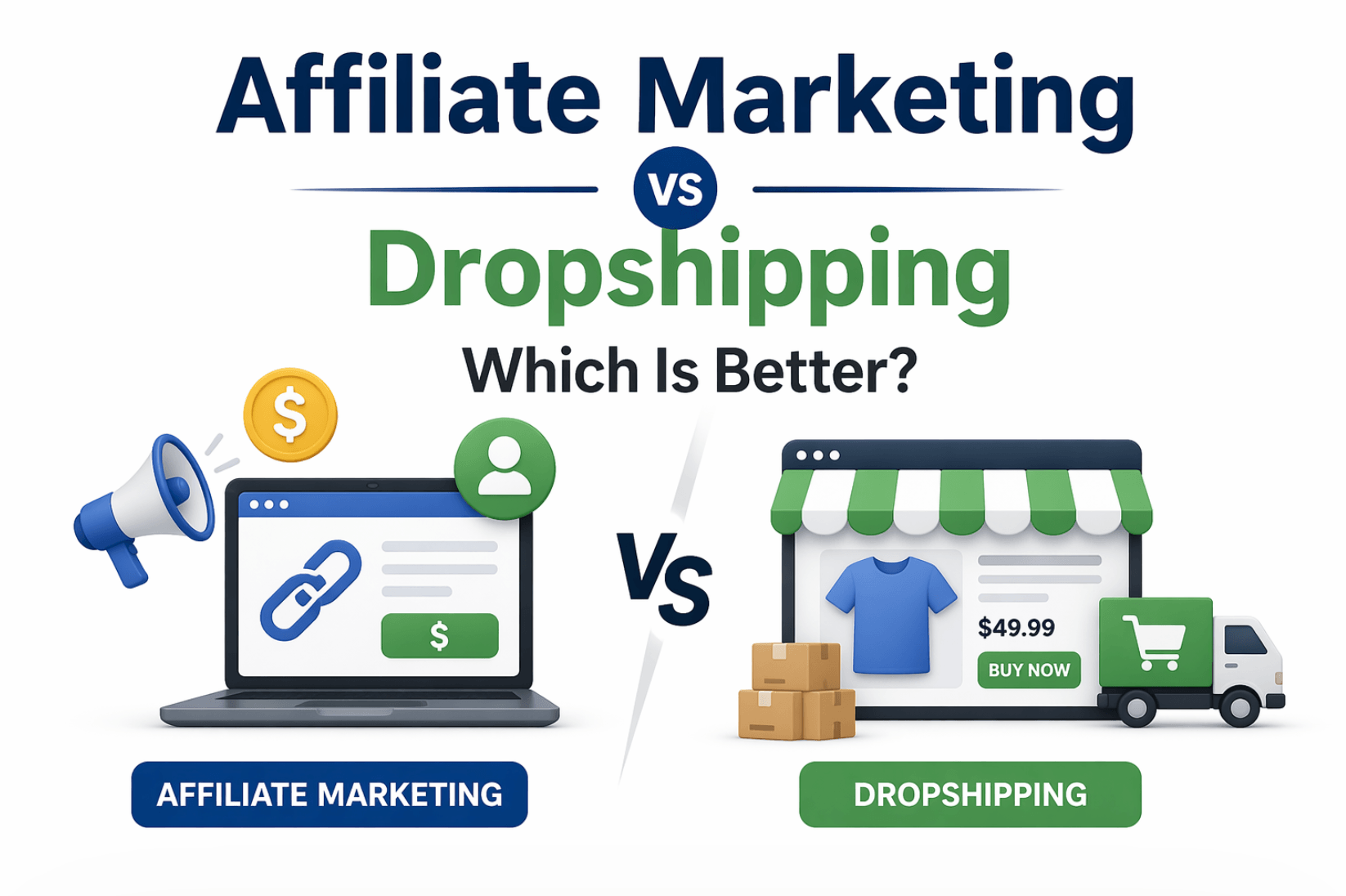
If you’ve been researching ways to make money online, you’ve almost certainly stumbled across these two models: affiliate marketing and dropshipping.
They come up together for a good reason: both offer a low-barrier entry into online income, neither requires you to hold physical inventory, and both can be run from a laptop anywhere in the world.
But that’s where the similarities end.
I’ve been building online income streams as an engineer living in Mexico, and I can tell you from experience that choosing the right business model early saves you months of wasted effort.
So let’s break this down properly, affiliate marketing vs dropshipping, so you can decide which path actually fits your goals, your skills, and your lifestyle.
What Is Affiliate Marketing?

Affiliate marketing is a model where you earn a commission by promoting someone else’s products or services.
You sign up for an affiliate program, get a unique tracking link, and earn a percentage of every sale made through that link.
Your job is purely promotional. You don’t own the product, you don’t manage inventory, you don’t deal with customer service.
You create content blog posts, YouTube videos, email newsletters, and social media, and direct your audience to the merchant’s offer.
How it works in practice
- You write a review article about a web hosting service.
- A reader clicks your affiliate link and signs up.
- You earn a commission (anywhere from $30 to $200+, depending on the program).
- The hosting company handles everything else.
Popular affiliate programs include Amazon Associates, ClickBank, Digistore24, ShareASale, and individual company programs like those offered by Bluehost, ConvertKit, or NordVPN.
What Is Dropshipping?
Dropshipping is a retail model where you sell physical products through your own online store, but a third-party supplier handles inventory and shipping.
When a customer orders from your Shopify store, for example, the order goes directly to your supplier, who ships it to the customer.
You set your own prices. You own the storefront. You manage the customer relationship.
How it works in practice
- You build a Shopify store selling fitness gear.
- A customer places an $80 order.
- You forward the order to your AliExpress or domestic supplier, paying $35.
- The supplier ships directly to the customer.
- You keep the $45 difference (minus platform and advertising fees).
Affiliate Marketing vs Dropshipping: Head-to-Head Comparison
Startup Costs
Affiliate Marketing has an extremely low barrier to entry. You can technically start for free — create a blog on a free platform, post on social media, or build an email list. Realistically, investing in a domain, hosting, and an email marketing tool puts your monthly costs at $20–$50. That’s it.
Dropshipping requires more upfront investment. You need an e-commerce platform (Shopify starts at ~$39/month), a domain, possibly a product research tool, and critically, an advertising budget. Most successful dropshippers run paid ads on Meta or TikTok to drive traffic, which can cost hundreds to thousands of dollars per month before you turn a profit.
Winner: Affiliate Marketing is far cheaper to start and sustain.
Profit Margins
Affiliate Marketing pays commissions typically between 5% and 30% on physical products, and up to 50–75% on digital products. High-ticket affiliate programs can pay $500+ per sale. You don’t control the commission rate, and the merchant can change it at any time.
Dropshipping lets you set your own prices, with margins typically ranging from 20% to 40% on physical goods. You control the spread between your supplier cost and retail price. However, once you factor in ad spend, platform fees, and payment processing, net margins often shrink to 10–20%.
Winner: It depends. Dropshipping gives you more margin control on physical goods, but high-ticket and digital affiliate programs can generate higher net income with less effort.
Passive Income Potential
This is where affiliate marketing genuinely shines. A well-ranking blog post or YouTube video can generate commissions for years after you create it. Write a thorough product review once, rank it on Google, and let it earn while you sleep. That’s the dream, and it’s actually achievable.
Dropshipping is not passive. It requires active management: monitoring ad campaigns, tracking supplier performance, handling returns, managing customer complaints, and testing new products. If you stop running ads, your revenue stops. It’s more like running a small business than building a passive asset.
Winner: Affiliate Marketing by a wide margin.
Customer Relationships and Responsibility
In affiliate marketing, you send traffic and walk away. The merchant owns the customer. If something goes wrong with the product, the customer deals with the merchant, not you. This massively reduces your operational burden.
In dropshipping, you own the customer relationship. If the supplier ships the wrong item, if the package is delayed, or if the product breaks, the customer comes to you. This means you need support systems, refund policies, and the emotional bandwidth to handle complaints.
Winner: Affiliate Marketing has zero liability for product or fulfillment issues.
Scalability
Affiliate marketing scales through content and audience. More quality content means more traffic, more trust, more commissions. Scaling can be slow at first, but compounds significantly over time — especially if you build an email list.
Dropshipping scales through advertising spend. Find a winning product and ad, increase your budget, and revenue scales fast. The problem is that the winning formula can stop working overnight when ad costs rise or a product trend fades.
Winner: Both scale well but through very different mechanisms. Affiliate marketing scales slowly but durably; dropshipping can scale fast but is more volatile.
Traffic Strategy
Affiliate marketing thrives on SEO, YouTube, and email. When someone searches “best protein powder for weight loss,” they’re already in buying mode. A well-optimized review article ranks in Google and converts. This is intent-based marketing at its finest, and it’s exactly what I focus on with my content sites.
Dropshipping works better with paid social Meta Ads, TikTok Shop, and Instagram. Visual, impulse-buy products perform well when someone sees them while scrolling, even without active search intent. TikTok Shop in particular has become a powerhouse for dropshipping, with reported 120% year-over-year sales growth in 2026.
Winner: Different models, different channels. Affiliate marketing suits SEO-focused content creators; dropshipping suits paid media operators.
Brand Building
Affiliate marketing builds your personal brand. Your audience trusts you. Your blog, your social accounts, and your email list are assets you own that grow in value over time. That trust translates into influence, which opens doors to sponsorships, digital products, consulting, and more.
Dropshipping can build a product brand, but most dropshippers operate anonymous stores that are hard to differentiate. Unless you evolve into private labeling or build genuine brand equity, you’re always one trending product away from starting over.
Winner: Affiliate Marketing superior for long-term brand and audience building.
The Numbers: Market Size and Growth
Both industries are booming. The global affiliate marketing industry is projected to grow from $27.8 billion in 2024 to $48 billion by 2027, with a CAGR of 18.6%. The global dropshipping market is even larger, valued at around $445 billion in 2025, with projections suggesting it could reach $1.25 trillion by 2030.
Both models have room to grow. The question isn’t which market is bigger, it’s which model suits you.
Affiliate Marketing vs Dropshipping: Pros and Cons Summary
Affiliate Marketing: Pros
- Extremely low startup cost.
- No customer service or fulfillment headaches.
- Passive income from evergreen content.
- Builds long-term audience and brand authority.
- Works anywhere in the world with minimal friction.
Affiliate Marketing: Cons
- Commission rates are set by the merchant (and can change).
- Takes time to build organic traffic.
- You don’t own the customer relationship.
- Income can fluctuate with algorithm changes.
Dropshipping: Pros
- You control your pricing and profit margins.
- Can scale rapidly with paid advertising.
- Can build a real e-commerce brand over time.
- More direct income potential in the short term.
Dropshipping: Cons
- Requires ongoing active management.
- Ad spend can be unpredictable and costly.
- Customer service and refund headaches.
- Product trends fade, winning formulas don’t last forever.
- Higher risk if ads stop converting.
Which Is Better for Beginners?
If you’re just starting, especially if you have limited capital, a day job, or you’re building from a laptop while living abroad, affiliate marketing is the smarter starting point.
Here’s why: you can start with almost nothing. You build content. That content accumulates traffic and authority. And over time, it pays you for work you already did.
That’s the model I’ve been building on this site: traffic, email, and offers. It’s not glamorous at first. But it compounds. And in a world where you want financial independence without the volatility of ad budgets and supply chain headaches, affiliate marketing gives you a path that feels more like building an asset than running a treadmill.
That said, if you have capital, enjoy e-commerce operations, and want faster short-term revenue, dropshipping can absolutely work, especially if you’re willing to learn paid traffic.
Can You Do Both?
Yes, and some of the most successful online entrepreneurs do exactly that.
A common hybrid strategy: build a content site with affiliate marketing to generate organic traffic and trust, then introduce your own products (or dropship products) to that warm audience.
This is how media brands evolve into e-commerce brands, and it’s a logical growth path once you have an established audience.
You can also use affiliate links to promote dropshipping-related tools (Shopify, Spocket, AutoDS) if you build content in the e-commerce space, layering both models in the same niche.
My Verdict: Affiliate Marketing Wins for Most People
For the vast majority of people reading this, especially those who want to build an income on the side, who don’t have large ad budgets, and who want something that compounds over time, affiliate marketing is the better choice.
It aligns with content creation. It builds real audience assets. It has a lower risk. And done right, it creates income streams that keep earning long after you stop actively working on them.
Dropshipping is a legitimate business, but it’s a business. It demands operations, capital, and continuous attention.
Affiliate marketing is better suited to building the kind of location-independent, growing online income that most people are actually looking for.
Final Thoughts
The affiliate marketing vs dropshipping debate doesn’t have one universal answer, but it does have an answer for you, based on your resources, your skills, and your goals.
If you want to build something sustainable on a budget, with real brand authority and passive income potential, start with affiliate marketing.
If you have capital, enjoy operations, and want faster cash flow through a more hands-on business, dropshipping might be your lane.
Either way, the best decision is the one you actually execute. Pick one, go deep, and give it real time before switching.
Want to learn more about building an online income from scratch? Check and download this roadmap.