I first stumbled into affiliate marketing in 2010, sitting in a university computer lab with a ClickBank account, a squeeze page I built from scratch, and a dream that felt bigger than my engineering coursework.
I didn’t make a fortune back then, but I learned enough to know that this model works when you build it the right way.
Fast-forward to today. I’m a full-time industrial automation engineer based in Mexico, and affiliate marketing is one of the pillars of the online income I’m building toward financial independence.
I’ve gone from solo ads and self-liquidating offers to a structured, sustainable setup that runs alongside my career.
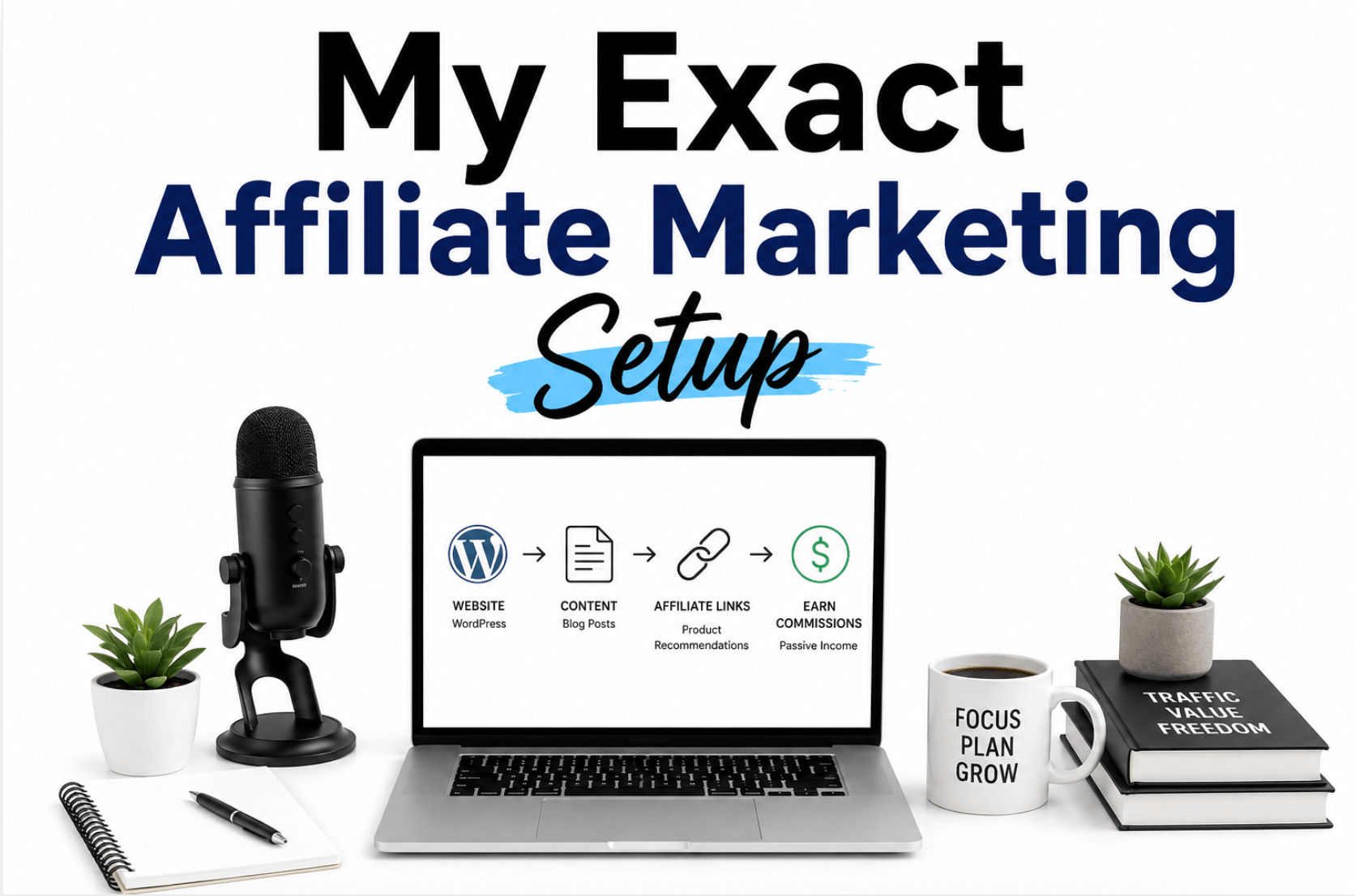
This article is not a theory. It’s my actual affiliate marketing setup, the tools I use, the decisions I made, and the logic behind each step. If you’re starting from zero or rebuilding your system, this is the blueprint I wish I’d had.
How I made my first affiliate sale
What Is an Affiliate Marketing Setup (And Why Yours Matters)
Affiliate marketing is simple: you promote someone else’s product, and you earn a commission when someone buys through your link.
But simple doesn’t mean easy. Most people who fail do so not because the model is broken, but because their setup is.
Your setup is the infrastructure behind your business, your niche, your traffic source, your content hub, your email list, and the affiliate programs you promote.
Get the setup right, and everything compounds. Get it wrong, and you’re pouring water into a leaky bucket.
Here’s mine, step by step.
Step 1: Pick a Niche You Can Own
Before any tool, any website, or any link, you need a niche. And not just any niche: one where you have real credibility, genuine interest, or lived experience.
I run content across several niches, and the ones that perform best are the ones where I actually have something to say.
For sekihudson.com, that niche is online business and affiliate marketing for people who want to build real income streams, particularly those with professional backgrounds who are making the shift from trading time for money to building scalable digital assets.
My background as an engineer-turned-entrepreneur gives me a perspective most affiliate marketing bloggers don’t have: I understand systems, I value precision, and I’ve built things from scratch before. That angle is my unfair advantage.
How to pick your niche
- Do you have professional expertise that maps to a real audience? (engineering, finance, healthcare, and education all work)
- Do you have a lived experience others are trying to replicate? (expat life, weight loss, career transitions)
- Is there a proven market with affiliate products to promote?
If you can say yes to at least two of those, you have a niche worth building.
Step 2: Build Your Content Hub (Your Blog)
Your blog is your headquarters. It’s the asset you own, the platform algorithms can’t take from you, and the place where SEO traffic compounds over time.
I use WordPress for all my sites, hosted on a reliable shared or managed host, depending on the site’s age and traffic level.
WordPress gives me full control, plays well with every SEO and affiliate tool I need, and has an ecosystem of themes and plugins that lets me build a professional site without a developer.
For sekihudson.com specifically, I keep the design clean and focused on content. The goal is for readers to trust me, not to be dazzled by design.
The non-negotiables for your blog:
- A custom domain (your name or brand, not a free subdomain)
- A fast, mobile-responsive theme
- An SSL certificate (https, non-negotiable for trust and SEO)
- Basic on-page SEO structure: clear headings, meta descriptions, internal links
Don’t over-engineer the blog before you have content. Ship something clean and start writing.
Step 3: Install the Right Plugins and Tools
Once the site is live, a handful of tools do the heavy lifting.
SEO
I use Rank Math (free tier is excellent) for on-page SEO guidance, meta titles, schema markup, and sitemap generation. Every article gets a focus keyword, a meta description, and a readability check before it publishes.
Analytics
Google Search Console and Google Analytics 4 are both free and essential. Search Console tells you what keywords are bringing traffic.
GA4 tells you what people do once they arrive. Together, they give you everything you need to make data-driven decisions.
Affiliate Link Management
I use ThirstyAffiliates (WordPress plugin) to cloak and organize my affiliate links. Instead of ugly tracking URLs littered through my posts, I use clean links like sekihudson.com/recommends/product-name. This improves click rates and makes link management much easier when programs change their URLs.
For sekihudson.com, I use Kit (formerly ConvertKit). More on this in Step 6.
Step 4: Choose Your Affiliate Programs
Not all affiliate programs are created equal. I focus on programs with:
- Recurring commissions where possible (software, memberships)
- Proven products I’ve actually used or thoroughly researched
- Reasonable cookie windows (30+ days minimum)
- Reliable tracking and on-time payouts
The platforms I actively use.
ClickBank
This is where I got my start back in university. ClickBank is a digital marketplace with thousands of products across virtually every niche.
Commission rates are high (often 50–75%), and it’s easy to get approved. The catch: product quality varies enormously, so you need to vet what you promote.
Digistore24
Similar to ClickBank but growing fast, especially in the European market. I find the interface cleaner, and the product selection is strong in the business, health, and self-improvement niches.
Amazon Associates
Lower commissions (usually 1–10%), but an enormous product range and a brand that converts. I use Amazon Associates for product recommendation posts where readers expect physical product links.
Direct programs
Many software companies run their own affiliate programs with better terms than networks. Tools like email marketing platforms, hosting providers, and course platforms often pay 20–50% recurring commissions. I apply directly through their websites.
The rule I follow
I only promote products I would recommend to a friend. My audience trusts me, and that trust is worth more than any single commission.
Step 5: Create Content That Ranks and Converts
Content is the engine. Without it, nothing else matters.
My content strategy for sekihudson.com focuses on search-intent-driven articles and posts that answer real questions people are already typing into Google. I write in three main content formats:
Informational posts
“What is X?” “How does X work?” “Why does X happen?” These build topical authority and bring in early-stage traffic.
Comparison posts
“X vs Y,” “Best X for [audience].” These attract readers who are closer to making a purchase decision.
Tutorial/how-to posts
Like this one. Step-by-step guides that demonstrate expertise and often include multiple affiliate touchpoints naturally.
My writing voice is direct and grounded in real experience. I’m an engineer, I don’t do fluff. I don’t pad articles with five paragraphs of preamble before getting to the point. Readers who find my content are smart, practical people, and I write accordingly.
My content process
- Keyword research (Rank Math + Google Search Console + common sense)
- Outline based on search intent
- Draft with a clear intro, structured sections, and actionable takeaways
- On-page SEO pass (headings, meta, internal links, image alt text)
- Publish and submit to Google Search Console for indexing
I aim for articles in the 1,500–3,000 word range for most topics, long enough to cover the subject thoroughly, short enough to respect the reader’s time.
Step 6: Build Your Email List From Day One
If I could go back and tell my 2013 self one thing, it would be this: start building your email list on day one.
The blog brings traffic. The email list is where that traffic becomes a relationship, and relationships are what convert.
For sekihudson.com, I use Kit to manage my list. The setup is straightforward.
Lead magnet
I offer a free resource that solves a specific problem for my target reader. This gives people a reason to hand over their email address. Make it genuinely useful, not a generic checklist that took you 20 minutes to make.
Opt-in forms
Embedded in relevant posts, in the sidebar, and as an exit-intent pop-up. I don’t plaster them everywhere, but I make sure they appear at moments when a reader has already shown interest.
Welcome sequence
Every new subscriber gets a short automated sequence, usually 4–5 emails, that introduces me, delivers the lead magnet, shares my story, and naturally moves toward a relevant affiliate offer or my own product.
Broadcast emails
Once a reader is through the welcome sequence, I send regular emails with useful content, personal insights, and occasional promotions. The ratio matters: lead with value, then sell.
Your email list is an asset you own. Your social following, your search rankings, and your platform reach can all be taken or disrupted. Your email list is yours.
How to build an email list for affiliate marketing
Step 7: Drive Traffic
A perfect setup with no traffic is a bookshelf in an empty room. You need people to find you.
My traffic strategy combines three channels.
SEO (primary)
Organic search is the highest-quality, most scalable traffic source for affiliate marketing. It takes time, usually 6–12 months before you see meaningful results, but once it compounds, it compounds hard. Every article I publish is an asset that can keep generating traffic for years.
X (Twitter)
I’m actively building my presence at @sekihudson. I share genuine insights about building online income alongside a professional career, personal observations, and behind-the-scenes content about the journey.
Social media drives direct traffic but also builds trust with the audience that eventually finds me through SEO.
Email (retention)
Once someone is on my list, email brings them back. A reader who visits once via Google might never return. A subscriber will hear from me regularly and return when the content is relevant to them.
I don’t try to be everywhere. I do SEO and X well, I build the email list consistently, and I let the system do the work.
Step 8: Track, Optimize, and Scale
The final piece is the feedback loop.
Every quarter, I review.
- Which posts are generating the most organic traffic (Google Search Console)
- Which posts are generating the most affiliate clicks and conversions (ThirstyAffiliates + program dashboards)
- Which emails have the highest open and click rates (Kit analytics)
- The gap is between the two high-traffic posts with low conversions, which often just need better call-to-action placement or a stronger offer
I update older posts, add internal links to new content, and double down on topics and formats that are working.
Affiliate marketing is not a “set it and forget it” business. It’s a system that rewards consistent refinement. But the compounding effect where one good article keeps generating commissions month after month is one of the most satisfying things I’ve experienced in business.
My Full Stack at a Glance
| Component | My Choice |
|---|---|
| Blog platform | WordPress |
| SEO plugin | Rank Math |
| Analytics | Google Search Console + GA4 |
| Affiliate link management | ThirstyAffiliates |
| Email marketing | Kit (formerly ConvertKit) |
| Affiliate networks | ClickBank, Digistore24, Amazon Associates + direct programs |
| Social media | X (@sekihudson) |
| Content strategy | SEO-first, search-intent driven |
Final Thoughts
I started this journey in a university computer lab with more curiosity than capital. Today, I run a structured system that generates affiliate income alongside a full engineering career, and I’m building toward the point where the digital income is the primary income.
The setup I’ve described here isn’t expensive to build. Most of the core tools have free tiers or low monthly costs. What it requires is time, consistency, and a willingness to learn in public.
If you’re starting, pick your niche, launch a simple blog, choose two or three affiliate programs, and write your first ten articles. That’s it. The sophistication comes later. The fundamentals work now.
Questions about any part of this setup? Drop them in the comments. I read everyone.