If you’ve been trying to make money with affiliate marketing but haven’t gotten anywhere, here’s the truth: posting random affiliate links on social media rarely works.
What actually works is a funnel, a simple, structured path that takes a stranger and walks them all the way to becoming a buyer.
In this guide, I’m going to show you exactly how to build an affiliate marketing funnel from scratch, even if you’re brand new, have zero audience, and have never made a single affiliate sale. By the end, you’ll have a clear blueprint you can start implementing today.
Let’s get into it.
What Is an Affiliate Marketing Funnel?
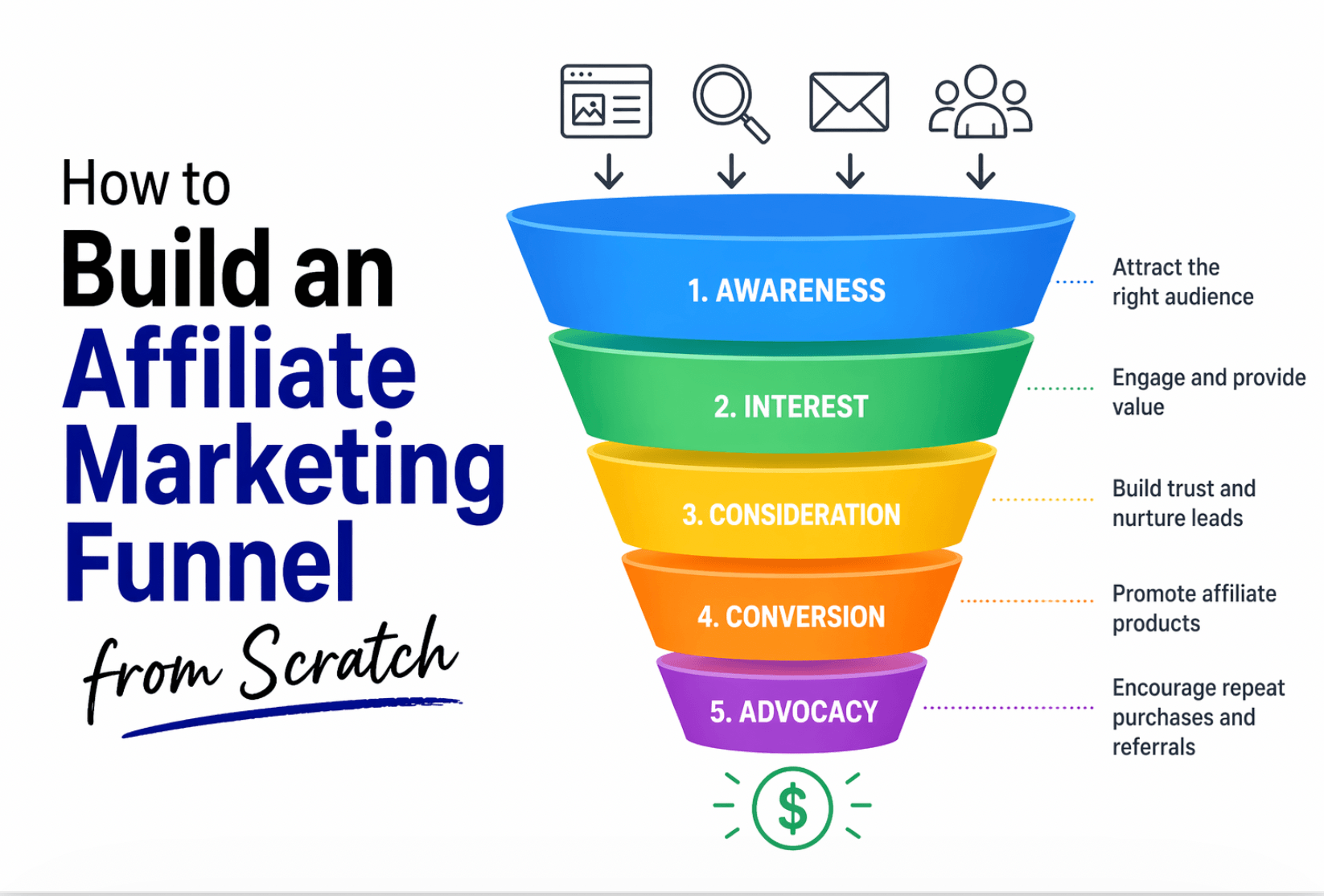
An affiliate marketing funnel is a step-by-step system designed to move people from “I just found you” to “I trust you enough to buy what you recommend.”
Think of it like a real-world journey
- Someone discovers your content (blog, YouTube, social media).
- They get curious and sign up for something free you’re offering.
- You build trust with them over email.
- You recommend a product that genuinely helps them.
- They buy you earn a commission.
The reason a funnel works so much better than just dropping affiliate links is simple: people buy from those they trust. The funnel is how you build that trust systematically and at scale.
Why Most Beginners Skip the Funnel (and Why That’s a Mistake)
Most beginners do this.
- Sign up for an affiliate program.
- Get their unique link.
- Post it on Instagram or in a Facebook group.
- Wonder why nobody clicks, let alone buys.
The problem isn’t the product. The problem is that there’s no relationship between you and the person seeing that link. They don’t know you. They don’t trust you. And they’re not ready to buy.
A funnel solves all of that.
The 4 Core Stages of an Affiliate Marketing Funnel
Before we get into the how-to, let me give you the big picture. Every effective affiliate funnel has four stages:
- Traffic: Getting people to notice you.
- Lead Capture: Getting their email address in exchange for something valuable.
- Nurture: Building trust through email:
- Conversion: Making the affiliate recommendation.
Each stage feeds into the next. Skip one, and the whole system breaks down. Get all four right, and you have a machine that can generate commissions even while you sleep.
Step 1: Choose Your Niche and Affiliate Offer
Before you build anything, you need to know who you’re helping and what you’re recommending.
Choosing Your Niche
Pick a niche that sits at the intersection of three things.
- Something you know about or are learning.
- Something people actively search for solutions to.
- Something with products to promote.
Good beginner-friendly niches include personal finance, weight loss, online business, fitness, parenting, relationships, and productivity. The key is to niche down, don’t target “fitness,” target “weight loss for busy moms over 40.”
The more specific you are, the easier it is to attract the right people and the more your recommendations will convert.
Choosing Your Affiliate Offer
Once you have your niche, find a product that.
- Genuinely solves a problem your audience has.
- Has a solid commission structure (look for 30–50%+ on digital products).
- Has good reviews and a reputation you can stand behind.
Good places to find affiliate offers.
- ClickBank: Digital products across dozens of niches.
- Digistore24: Similar to ClickBank, strong in European markets.
- Amazon Associates: Physical products, lower commissions, but huge trust.
- ShareASale / CJ Affiliate; Brands and software.
- Individual programs: Many SaaS tools (email platforms, course builders) run their own affiliate programs with recurring commissions.
Pro tip: Recurring commissions are gold. When someone you referred pays monthly, you keep earning monthly. Look for these whenever possible.
Step 2: Create a Lead Magnet
A lead magnet is a free resource you offer in exchange for someone’s email address. This is the engine of your funnel.
Think about it: if someone is willing to give you their email, they’re telling you they’re genuinely interested in the topic. That’s a much warmer prospect than a random social media follower.
What Makes a Good Lead Magnet?
Your lead magnet should be.
- Specific: “5 Foods That Burn Belly Fat” beats “Health Tips”.
- Immediately useful: Something they can act on today.
- Directly connected to your affiliate offer: If your offer is a weight loss program, your lead magnet should be about weight loss.
Lead Magnet Ideas for Beginners
- A short PDF checklist or cheat sheet.
- A “quick start” guide (5–10 pages).
- A short email mini-course (5 emails over 5 days).
- A swipe file or resource list.
- A simple video tutorial.
You don’t need anything fancy. A clean, well-organized PDF created in Canva or Google Docs is perfectly fine for starters.
Step 3: Build a Landing Page
Your landing page (also called an opt-in page or squeeze page) has one job: get people to sign up for your lead magnet.
Nothing more, nothing less. No distractions, no blog posts, no navigation menu. Just a clear headline, a brief description of what they’re getting, and a signup form.
What Your Landing Page Needs
- A headline that speaks directly to a problem or desire (“Grab My Free Guide: Lose Your First 10 Pounds Without Giving Up Your Favorite Foods”).
- 3–5 bullet points highlighting what they’ll get from the lead magnet.
- A simple opt-in form with just name and email (fewer fields = more signups).
- A call to action button with action-oriented copy (“Send Me the Free Guide!”).
Tools to Build Your Landing Page
- MailerLite: Free plan includes landing pages and email automation. Great for beginners.
- ConvertKit / Kit: Also offers landing pages with the free plan
- Carrd: Simple, cheap, and beginner-friendly
- WordPress + Elementor: More control, great if you already have a blog.
Keep the design clean. Remove anything that doesn’t push people toward clicking that button.
Step 4: Set Up Your Email Automation
This is where the magic happens. Once someone signs up, your email sequence takes over automatically, delivering value, building trust, and eventually making your affiliate recommendation.
The Basic Email Sequence Structure
For a simple affiliate funnel, you need 5–7 emails spread over 5–10 days. Here’s a framework that works.
Email 1 (Immediate): Deliver the goods
Send the lead magnet right away. Keep this email short and warm. Welcome them, deliver what you promised, and set expectations for what’s coming.
Email 2 (Day 2): Tell your story
Share a personal story related to the niche. Why are you here? What problem did you face? What did you learn? This is how you become a real person to your subscriber, not just another faceless marketer.
Email 3 (Day 3): Teach something valuable
Give them a quick win, a tip, a strategy, or an insight they can use immediately. Pure value, no selling. This builds your authority.
Email 4 (Day 5): Address a common mistake
Talk about a mistake most people in your niche make (one you’ve likely made yourself). This positions you as someone who gets it and naturally sets up your solution.
Email 5 (Day 7): Introduce the offer
This is where you make your affiliate recommendation. Frame it as a tool or resource that helped you, or that solves the exact problem you’ve been discussing. Include your affiliate link naturally within the email.
Email 6 (Day 8): Handle objections
Address the most common hesitations people have about the product. Price, time commitment, and whether it will work for them tackle these directly and link again.
Email 7 (Day 10): Final nudge
A shorter email that creates a light sense of urgency or simply reminds them about the resource one more time. Keep it conversational.
Email Marketing Tools to Use
- MailerLite: Generous free plan (up to 1,000 subscribers), good automation.
- Kit (ConvertKit): Creator-focused, excellent for content-driven funnels.
- AWeber: Reliable and beginner-friendly.
- GetResponse: Good if you plan to add webinars later
All of these allow you to set up automated sequences, so once you write the emails, they go out on autopilot every time someone new joins your list.
Step 5: Drive Traffic to Your Funnel
You’ve got your lead magnet, landing page, and email sequence ready. Now you need eyeballs.
Traffic is the lifeblood of your funnel. Without it, nothing else matters. Here are the main options.
Free Traffic Sources
Blogging / SEO
Write articles that answer the questions your target audience is typing into Google. This takes time to build (3–6 months minimum), but the traffic is free and compounds over time. This is one of the most sustainable long-term strategies.
YouTube
Videos rank on Google too, and YouTube is the world’s second-largest search engine. If you’re comfortable on camera, this is a powerful traffic source.
Social Media (Organic)
Platforms like Pinterest, X (Twitter), and Facebook Groups can drive traffic, especially early on when you don’t have domain authority yet. Focus on one platform and be consistent.
Quora / Reddit / Forums
Answer questions in your niche with genuine, helpful answers. You can reference your content naturally where appropriate.
Paid Traffic (Once You’re Ready)
Once your funnel is proven, meaning it converts at least some of your email subscribers into buyers, you can scale with paid ads.
- Facebook/Instagram Ads: Great targeting, good for lead generation.
- Google Ads: High intent traffic, can be expensive in competitive niches.
- Pinterest Ads: Underrated, works well for visual niches (food, fitness, home, finance).
Important: Don’t pay for traffic until you’ve validated your funnel with free traffic first. You don’t want to spend money to send people to a funnel that doesn’t convert.
Step 6: Track, Test, and Optimize
Here’s something most beginner guides won’t tell you: your first funnel probably won’t be perfect. And that’s completely fine.
The goal isn’t perfection on launch day. The goal is to get it live, get data, and improve.
Key Metrics to Watch
- Landing page conversion rate: What percentage of visitors sign up? Aim for 20–40%+
- Email open rate: Are people opening your emails? 30–40% is solid
- Click-through rate (CTR): Are people clicking your affiliate links?
- Conversion rate: Of those who click, how many buy?
If your landing page has a low conversion rate, test a different headline. If your emails have low open rates, test different subject lines. If people click but don’t buy, the problem might be the offer itself or how you’re presenting it.
Small improvements compound dramatically. Going from a 20% landing page conversion to 30% means 50% more leads from the same traffic.
Putting It All Together: Your Funnel Checklist
Here’s a quick summary of everything you need to build your first affiliate marketing funnel:
- Niche selected and audience defined
- Affiliate offer chosen (and personally reviewed)
- Lead magnet created (PDF, checklist, mini-course)
- Landing page live with opt-in form connected
- Welcome email delivers the lead magnet
- 5–7 email sequence written and automated
- Traffic strategy chosen and in motion
- Tracking set up (Google Analytics, email stats)
You don’t need to have all of this perfect before you start. Build it one piece at a time. Get the landing page up. Write the first three emails. Start driving traffic. Add and improve from there.
Common Beginner Mistakes to Avoid
Promoting too many products at once
Pick one offer per funnel. Trying to promote five products in seven emails confuses people and dilutes your conversions.
Making the landing page too complicated
Strip it back. One headline. One promise. One form. That’s it.
Quitting too soon
Most people give up before their SEO content starts ranking or before their email list reaches a critical mass. Funnels reward persistence. Give it at least 90–180 days before concluding.
Promoting products you’ve never used
Your subscribers will eventually figure it out. Stick to products you can speak to authentically or, at a minimum, products you’ve thoroughly researched and genuinely believe in.
Ignoring the relationship
The emails aren’t just a delivery mechanism for affiliate links. They’re how you build a real relationship with real people. Write like a human. Share your experiences. Be honest.
Final Thoughts
Building an affiliate marketing funnel from scratch isn’t complicated, but it does take consistent effort and the willingness to learn as you go.
The beauty of this model is that once your funnel is built and your traffic is flowing, it works for you around the clock.
Every new person who finds your content and signs up enters your sequence automatically. Your emails go out automatically. Your affiliate recommendations go out automatically.
That’s what leverage looks like in the online business world.
Start simple. One niche. One offer. One lead magnet. One landing page. One email sequence. Drive traffic, watch the data, and improve.
The goal isn’t to build the perfect funnel on day one. The goal is to build a funnel, make your first sale, and then build from there.
You’ve got everything you need to start. Now go build it.
Want more beginner-friendly guides on building an online income? Browse the blog at SekiHudson.com or join the email list below to get the next guide straight to your inbox.