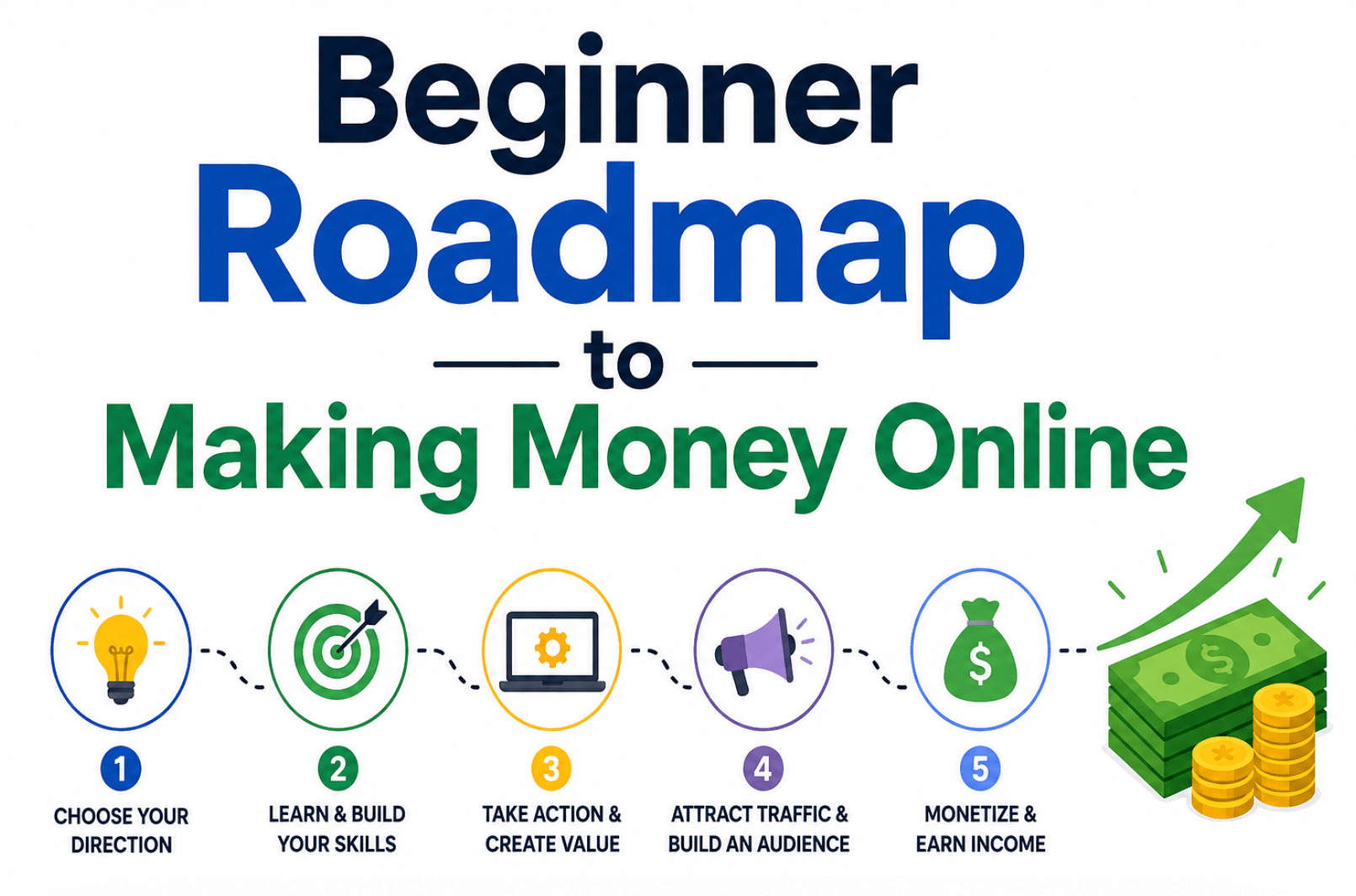
Every day, thousands of people type “how to make money online” into Google.
They watch a few YouTube videos. They download a freebie. They may even buy a course.
And then nothing. Six months later, they’re back at square one, wondering why it didn’t work for them.
I’ve been there. I started my first online business around 2012, following squeeze-page tutorials, running ClickBank offers on solo ads, and praying that something would stick. It didn’t. Not because the opportunity wasn’t real, but because I had no roadmap.
I was just winging it.
Fast forward to today: I’m an engineer based in San Luis Potosí, Mexico, building a real portfolio of online income streams, including affiliate marketing, content blogs, email lists, and digital products.
And the biggest difference between the version of me that failed and the version that’s winning?
A clear, step-by-step system.
That’s what this guide is. Not a list of random side hustles. Not “10 ways to make $500 tonight.” This is a genuine beginner roadmap to making money online, built on the same framework I use myself and the same one that’s helped countless regular people build sustainable income online.
If you’re ready to stop spinning your wheels and start building something real, this is your starting point.
What is “Making Money Online”? Actually Means (And What It Doesn’t)
Before we get into the roadmap, let’s kill a myth.
Making money online is not
- A get-rich-quick scheme
- Passive income that appears out of thin air
- Something only tech-savvy people can do
- Limited to influencers or people with millions of followers
It is
- A legitimate set of business models that operate over the internet
- Something that requires real work, especially in the beginning
- Accessible to anyone with a laptop, WiFi, and the willingness to learn
- A long game, but one with a very real finish line
There are dozens of ways to earn online. But for beginners, the key is narrowing it down to models that are proven, low-cost to start, and scalable over time. That’s exactly what this roadmap does.
The 5 Best Online Income Models for Beginners
Not all online business models are created equal. Some require a huge upfront investment. Others demand skills you’d need years to build. The following five are the best starting points for most beginners.
Affiliate Marketing
Affiliate marketing is the process of earning a commission by recommending other people’s products or services.
You don’t create the product. You don’t handle customer service. You simply drive traffic to an offer, and when someone buys through your unique link, you get paid.
Why it’s great for beginners
- Zero inventory, zero product creation
- Low startup cost (often just a domain and hosting)
- Works 24/7 once you’ve built the content
- Scalable across multiple niches
How it works
- Join an affiliate program (Amazon Associates, ClickBank, Digistore24, ShareASale, etc.)
- Get your unique affiliate link
- Create content (blog posts, emails, social posts) that recommends the product
- Earn a commission when someone clicks your link and buys
This is the primary model I use across my blogs, and it’s the one I recommend that most new beginners start with.
Blogging with SEO
A blog is your online real estate. When you write content that ranks on Google, you get free, organic traffic to your site every single day without paying for ads.
Combine a blog with affiliate marketing, and you have a system that generates income while you sleep.
Why it’s great for beginners
- Low cost to start (under $100/year for domain + hosting)
- Compounds, over time: older content keeps ranking
- Builds authority and trust in your niche
- Multiple monetization options (ads, affiliates, products, sponsorships)
The key to blogging success
Pick a focused niche, write content targeting keywords your audience is searching for, and stay consistent. SEO is a slow burn, but when it kicks in, it’s one of the most powerful engines in online business.
Email Marketing
The money is in the list. You’ve heard this before. It’s still true.
Email marketing is the practice of building a list of subscribers who have opted in to hear from you and then promoting products, services, or content to that list.
Email has the highest ROI of any digital marketing channel. It’s also something you own. Unlike social media followers, your email list can’t be taken away by an algorithm update.
Why it’s great for beginners
- Start free with tools like Kit (formerly ConvertKit) or MailerLite
- Works in every niche
- Converts better than social media traffic
- Can be automated with sequences and broadcasts
The key
Give people a compelling reason to subscribe (a free guide, checklist, or resource), then deliver consistent value before making offers.
Digital Products
Digital products, such as ebooks, guides, templates, mini-courses, and toolkits, are low-cost to create and can be sold indefinitely with zero fulfillment costs.
If you have knowledge or expertise in any area (fitness, finance, cooking, parenting, or a specific skill), you can package that into a digital product and sell it online.
Why it’s great for beginners
- Create once, sell forever
- High profit margins (no cost of goods)
- Works with even a small audience
- Platforms like Gumroad and Payhip make selling simple
Freelancing
Freelancing means selling your skills (writing, design, coding, video editing, SEO, social media management) to clients online.
It’s the fastest way to make your first online dollar because you’re trading time for money, but it’s a real business and a legitimate starting point.
Why it’s great for beginners
- No audience needed
- Start earning within days or weeks
- Platforms like Fiverr, Upwork, and Contra connect you with clients fast
- Build portfolio and skills while getting paid
The caveat
Freelancing doesn’t scale the same way affiliate marketing or blogging does. But it’s an excellent bridge to earn freelance income while building your passive income systems on the side.
The Beginner Roadmap: Step by Step
Now that you understand the landscape, here’s the actual roadmap. These are the exact steps I’d follow if I were starting from scratch today.
Step 1: Get Clear on Your “Why”
This might sound soft, but it’s the most important step.
Why do you want to make money online? What would change in your life if you had an extra $1,000/month? $5,000? What would financial independence look like for you?
Write it down. Make it specific. This becomes the anchor that keeps you going when results are slow, and results will be slow in the beginning.
My “why” was simple: I didn’t want to be dependent on a single employer’s paycheck for the rest of my life.
I wanted freedom to work from anywhere, to invest, and to provide for my family without financial anxiety.
What’s yours?
Step 2: Choose ONE Model and ONE niche.
The biggest mistake beginners make is trying to do everything at once.
Pick one business model. Then pick one niche to operate in.
Choosing your niche.
A good niche is
- Something you have some knowledge of or a genuine interest in
- Something people actively spend money on (health, wealth, relationships, hobbies)
- Something with enough of an audience to build a real business around
You don’t need to be the world’s leading expert. You just need to know more than the person you’re helping and be willing to document your journey.
My recommendation for most beginners
Start with affiliate marketing + blogging. It’s low-cost, it’s scalable, and it builds compounding assets (SEO content) over time.
Step 3: Set Up Your Foundation
Once you’ve picked your model and niche, you need the infrastructure in place.
For a blog-based affiliate marketing business, your foundation is there.
Domain name
Your website address. Keep it short, brandable, and relevant to your niche. Register it through Namecheap ($10–$15/year).
Web hosting
Where your website lives. WPX Hosting is my personal choice for speed and support. Alternatives include SiteGround or Cloudways.
WordPress
The world’s most popular website platform. Free and flexible.
Rank Math SEO plugin
Makes on-page SEO simple. The free version is excellent.
An email service provider
Kit (ConvertKit) or MailerLite for building your list.
Total startup cost: around $100–$200 for your first year. That’s it.
Step 4: Learn the Traffic→Email→Offer Framework
This is the core framework that powers every successful online income business.
Traffic → Email → Offer
Here’s how it works:
Traffic is how people find you. This can come from:
- SEO (people searching Google and finding your blog posts)
- Social media (X/Twitter, Pinterest, YouTube, Instagram, TikTok)
- Paid ads (Facebook, Google, not recommended until you know what you’re doing)
Email is how you capture and own that traffic. A percentage of your visitors will join your email list in exchange for a free resource (your “lead magnet”). Now they’re yours, not Facebook’s, not Google’s.
An offer is how you monetize. You promote relevant products or services to your email list and blog readers and earn commissions or sales when they buy.
Master this funnel, and you understand the engine behind virtually every successful online business.
Step 5: Create Your First Piece of Content
Don’t wait until everything is perfect. Start creating.
Write your first blog post. Record your first YouTube video. Send your first email. Post your first tweet.
Your first piece of content will be imperfect. That’s fine. The only way to get better is to start.
For a blog, your first content should include
- A “Start Here” page that introduces you and your journey
- 5–10 foundational posts targeting keywords in your niche
- At least one lead magnet to start building your email list
Use tools like Google Search Console, Ahrefs, or even just Google’s autocomplete to find keywords people are actively searching for. Then write content that genuinely answers their questions.
Step 6: Build Your Email List from Day One
Most beginners wait until they have “enough traffic” to build their email list.
This is a mistake.
Start building your list from your very first visitor.
Create a simple lead magnet, a free checklist, guide, or resource that solves a specific problem for your audience. Put it behind an opt-in form on your website. Promote it in your content.
Even if you only collect 10 subscribers in your first month, those 10 people are more valuable than 10,000 social media followers, because you can reach them directly.
Step 7: Promote Relevant Affiliate Offers
Once you have content and a small audience, it’s time to monetize.
Look for affiliate programs in your niche. The best offers are:
- Products or services you’ve actually used or genuinely believe in
- High-quality enough that recommending them builds your credibility
- Well-compensated (good commission rates and decent conversion rates)
Where to find affiliate offers
- Amazon Associates (physical products, trusted brand)
- ClickBank and Digistore24 (digital products, higher commissions)
- ShareASale and CJ Affiliate (wide range of brands)
- Individual affiliate programs (many companies run their own)
Integrate your affiliate links naturally into your content, product reviews, comparison posts, “best of” roundups, and tutorials. Don’t just spam links. Provide genuine value first.
Step 8: Be Consistent for 6–12 Months
This is where 90% of beginners quit.
Online business results are not linear. They’re exponential. The first few months feel like nothing is happening.
Then something clicks, a post starts ranking, an email list grows, a product sells, and momentum builds.
But you have to be consistent long enough to reach that inflection point.
What consistency looks like:
- Publishing at least 2–4 new blog posts or content pieces per week
- Sending at least one email to your list per week
- Showing up on 1–2 social platforms regularly
- Tracking your analytics and adjusting what isn’t working
Set a 6-month commitment minimum. Treat it like a part-time job with massive upside.
Step 9: Reinvest and Scale
Once you’re making a consistent income, even a few hundred dollars a month, it’s time to reinvest.
- Reinvest in better tools (premium SEO software, email marketing, design tools)
- Outsource tasks that drain your time (content writing, social scheduling)
- Build more content, more email sequences, more offers
- Expand to adjacent niches or additional income streams
This is how a side income becomes a full-time income. Slowly, then suddenly.
Common Beginner Mistakes to Avoid
Learning from other people’s mistakes is faster (and cheaper) than making your own.
Mistake #1: Chasing every shiny object
There will always be a new platform, a new tactic, a new “way to make money online.” The fundamentals of traffic, email, and offers never change. Master the basics before exploring anything else.
Mistake #2: Building on rented land
Social media followers are not assets. A Google Business profile is not your business. Your email list and your website are your true assets. Build there first.
Mistake #3: Not tracking anything
You cannot improve what you don’t measure. Check your analytics weekly: traffic, email open rates, click-through rates, and affiliate conversions. The data tells you what to do next.
Mistake #4: Giving up at month 3
Three months is not enough time to evaluate any online business. Most successful blogs take 8–12 months to gain serious traction.
Most email lists don’t start converting well until they reach 500–1,000 subscribers. Play the long game.
Mistake #5: Waiting until you’re “ready.”
You will never feel ready. Start before you feel ready. Adjust as you go.
Tools You Need to Get Started (And What You Can Skip)
Must-Have Tools
| Tool | Purpose | Cost |
|---|---|---|
| Namecheap | Domain registration | ~$12/year |
| WPX Hosting or SiteGround | Web hosting | $10–$30/month |
| WordPress | Website platform | Free |
| Rank Math SEO | On-page SEO | Free |
| Kit (ConvertKit) or MailerLite | Email marketing | Free up to 1,000 subs |
| Canva | Graphics & social images | Free |
| Google Search Console | Track search performance | Free |
Nice-to-Have (After Month 3–6)
| Tool | Purpose | Cost |
|---|---|---|
| Ahrefs | Keyword research, competitor analysis | $99+/month |
| ThirstyAffiliates | Affiliate link management | ~$80/year |
| Canva Pro | Advanced design | $13/month |
Skip for Now
- Paid ads (until you have a proven funnel)
- Expensive course bundles (the free/affordable resources are enough to start)
- Complex tools you’ll never use
Start lean. Scale your tool budget as your income grows.
How Long Does It Take to Make Your First Dollar Online?
Honest answer: It depends on your model and how consistently you execute.
| Model | Time to First Dollar |
|---|---|
| Freelancing | Days to weeks |
| Affiliate marketing (blog/SEO) | 3–12 months |
| Email marketing | 1–3 months (with existing traffic) |
| Digital products | Weeks (with a small audience) |
| Blogging (display ads) | 6–18 months |
SEO-based affiliate marketing is slower to start, but once it’s working, it generates income passively and compounds month over month. Freelancing is faster but doesn’t scale the same way.
Most beginners do best by combining freelancing or a quick-win method to generate early income while building the slower, more scalable systems in the background.
Frequently Asked Questions
Do I need a lot of money to start making money online?
No. You can start a blog-based affiliate marketing business for under $100. Many successful online entrepreneurs started with just a domain and hosting.
The tools that matter most in the beginning are WordPress, Google Search Console, and Kit’s free plan, which cost nothing.
Do I need technical skills?
No. WordPress is drag-and-drop. Email marketing platforms have simple editors. The skills you actually need are writing, critical thinking, and consistency, not coding.
Can I make money online with no experience?
Yes, but expect a learning curve. The first 3–6 months are largely about learning the fundamentals: SEO, affiliate marketing, email marketing, and content strategy. Be patient with yourself. Everyone successful online was once a complete beginner.
How many hours per week do I need to commit?
10–15 hours per week is enough to build a real online business alongside a full-time job, but only if those hours are focused and strategic. Consistency beats intensity. 2 focused hours per day beats 14 random hours on the weekend.
Should I start with social media or a blog?
Both serve different purposes. A blog builds compounding SEO assets that generate traffic for years. Social media builds relationships and audiences faster but requires constant activity.
My recommendation: start with a blog, use social media to amplify your content, and build your email list through both.
Is affiliate marketing saturated?
No. As long as people search for things on Google and buy products online, affiliate marketing will be viable. Yes, some niches are more competitive than others.
But every niche has underserved sub-topics. Good research and consistent content will always find an audience.
What’s the fastest way to make my first $100 online?
Freelancing. If you have any marketable skills, like writing, design, video editing, social media management, or virtual assistance, you can earn within days on platforms like Fiverr or Upwork. Use that early income to fund your longer-term content business.
Can I do this from outside the US?
Absolutely. I run my entire online business from Mexico as a permanent resident. The internet doesn’t care where you live. With tools like Wise Business for payments and international affiliate platforms like Digistore24, you can operate from virtually anywhere in the world.
Your Next Step
You’ve made it to the end of the roadmap. Here’s what to do right now, today, not someday.
- Decide on your model. If you’re not sure, start with affiliate marketing + blogging.
- Pick a niche. One that you know something about and that people spend money on.
- Register your domain. It takes 10 minutes and costs about $12.
- Set up your WordPress site. Basic, functional, life.
- Write your first piece of content. Don’t wait until it’s perfect.
The gap between people who make money online and people who don’t is rarely about information. It’s an action.
You now have the roadmap. The only thing left to do is walk it.