Most entrepreneurs spend months building the wrong things. Here’s the brutally simple system that actually makes money online and how to build it from scratch.
I used to believe that building a successful online business required the right branding, the perfect website, the ideal niche, and a complicated funnel with seven steps, three upsells, and a partridge in a pear tree. I was wrong. Dead wrong.
The entrepreneurs who are actually generating consistent income online aren’t running complex systems.
They’re running the same dead-simple three-step model over and over until it works. Once I stripped everything back and started paying attention to what these people were actually doing rather than what they were teaching, the pattern was impossible to miss.
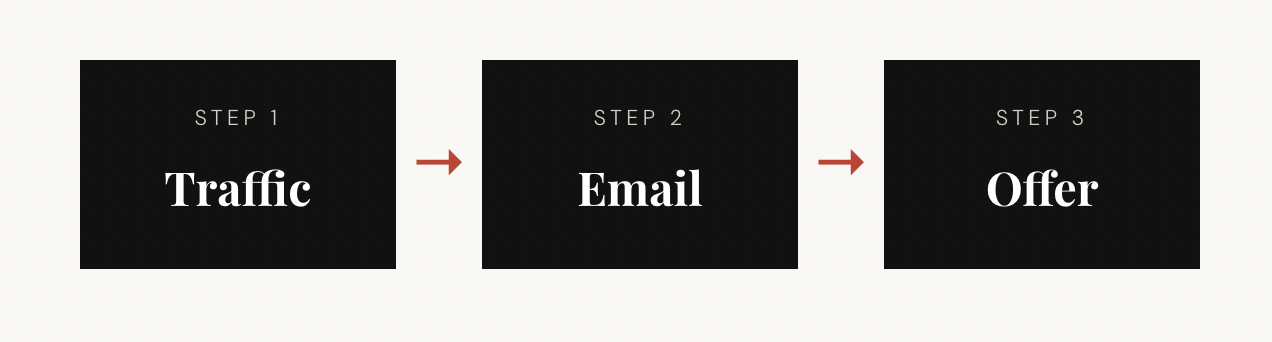
“You make money online by building a simple funnel. Traffic → Email → Offer. That’s it.”
If you’ve been spinning your wheels posting content, tweaking landing pages, and building courses nobody buys, this article is your reset button. Let’s walk through each step so you understand not just what to do, but why it works.
Step 1 Traffic: Get In Front of People
Traffic is the fuel of your funnel. Without it, nothing else matters. But traffic doesn’t mean going viral, dancing on TikTok, or growing to 100,000 followers. Traffic means people seeing your content consistently, on one platform, over time.
The biggest mistake beginners make is trying to be everywhere at once. They post on Instagram, LinkedIn, YouTube, X, Pinterest, and a podcast, and they burn out within three months, having built no real audience anywhere.
The smarter approach: Pick one platform where your ideal customer already spends time, and commit to it for at least 90 days.
- Short-form video (TikTok, Instagram Reels, YouTube Shorts) has the fastest growth and the lowest barrier to entry.
- Long-form content (YouTube, blog, and podcast) is slower to build but creates deeper trust and SEO value.
- Written social (X/Twitter, LinkedIn), excellent for B2B and thought leadership.
- Community-led (Facebook groups, Reddit, forums), great for niche audiences.
- Paid ads only once you have a proven offer and know your numbers.
The Golden Rule of Traffic
Pick one platform. Create content that genuinely helps your ideal customer solve a problem or see the world differently. Do it consistently.
That’s the entire traffic strategy. The platform doesn’t matter nearly as much as the consistency and the quality of what you share.
Every piece of content you create should have one job: move interested people to the next step. Which brings us to the most important part of the funnel.
Step 2 Email: Own the Relationship
If traffic is the fuel, email is the engine. This is the step most beginners skip entirely, and it’s the single biggest reason they never make consistent money online.
Here’s the hard truth about social media: you don’t own your followers. An algorithm update, an account ban, or a platform dying (remember Vine?) can wipe out years of audience-building overnight. Your email list, on the other hand, is an asset you own. No platform can take it away.
More importantly, email is where trust is built. Someone who has invited you into their inbox is far more likely to buy from you than a casual follower scrolling past your post.
- Create a free lead magnet (checklist, guide, template, mini-course) your audience actually wants.
- Build a simple opt-in page with one clear headline, one benefit statement, and one button.
- Use an email platform (ConvertKit, Beehiiv, or Mailchimp) to deliver it automatically.
- Send valuable, personality-driven emails 1–3 times per week.
- Build trust consistently before you ever make an offer.
“Social media followers are rented. Your email list is owned. Build what you own.”
The ratio that works: for every promotional email you send, send at least two or three that are purely valuable, like a lesson, a story, or a resource.
When you do this right, your subscribers look forward to hearing from you. And when you eventually make an offer, they trust you enough to buy.
Step 3: Offer: Sell Something That Solves a Problem
This is where the revenue lives. Your offer is what you sell to your email list, and it doesn’t need to be complicated.
It just needs to solve a specific, painful problem for a specific group of people, at a price they consider fair.
Here’s what a lot of beginners get wrong: they spend months building a premium course before they’ve validated that anyone wants it. The smarter move is to start simple and let your audience tell you what they’ll pay for.
- Digital products (ebooks, templates, swipe files), low price point ($7–$97), high volume potential, fully passive.
- Online courses or workshops ($197–$997), medium-priced, require more trust and positioning.
- Coaching or consulting ($500–$5,000+), high price, low volume, fastest path to revenue.
- Memberships or communities, recurring revenue, require strong ongoing value delivery
- Affiliate offers, promote other people’s products, and earn a commission, while building your own.
Start Simple, Then Scale
If you’re just getting started, don’t build a 10-module course. Start with a $27 PDF that solves one problem brilliantly. Or offer one-on-one coaching at a rate that feels accessible to your audience.
Get your first 10 customers. Learn what they love and what they wish were different. Then build something bigger.
The goal of your first offer isn’t to make you rich. It’s to prove the model works that people in your audience have a problem, that they trust you enough to pay for a solution, and that you can deliver results. Once you’ve proven that, scaling is just a matter of sending more traffic into the same funnel.
How to Diagnose What’s Not Working
One of the biggest advantages of the Traffic → Email → Offer model is how easy it makes troubleshooting.
Because it’s linear and modular, you can identify exactly which step is broken and fix it without rebuilding everything from scratch.
| Symptom | What it tells you | Where to focus |
|---|---|---|
| No subscribers | Traffic isn’t converting to the list. | Improve your lead magnet or opt-in page. |
| Low open rates | Subscribers aren’t engaged. | The offer isn’t landing |
| Opens but no sales | The offer isn’t landing. | Revisit your positioning, price point, or timing. |
| No traffic at all | Content isn’t reaching people. | Double down on one platform and post more consistently. |
| Everything feels slow | The system is right; patience is needed. | Keep going; compounding takes time. |
Why Simple Systems Win
There’s a reason the most successful online business owners keep coming back to this model. Simple systems are easier to build, easier to maintain, easier to fix, and most importantly, easier to actually execute consistently over time.
Complicated systems give you excuses to procrastinate. If you need 14 tools, 6 automations, a custom domain, a Kajabi account, and a graphic designer before you can “launch,” you’re going to keep not launching. The Traffic → Email → Offer funnel can be running in a week with free tools and one piece of content.
The entrepreneurs who win aren’t the ones with the most sophisticated systems. They’re the ones who picked a simple system and refused to stop until it worked.
“Simple systems are easier to fix. And easier systems actually get done.”
Your Next Step
Here’s the only question that matters after reading this: which step are you missing right now?
If you don’t have consistent traffic, pick one platform today and commit to showing up three times a week for the next 90 days.
If you don’t have an email list, create a simple lead magnet this week and set up a free opt-in page. If you don’t have an offer, write down the top three questions your audience keeps asking. The answer to one of those questions is your first product.
You don’t need to do all three at once. You just need to identify your weakest link and strengthen it. The funnel will do the rest.