The affiliate game has changed. Here’s the insider playbook that separates passive-income earners from those who never see a commission.
Let’s be honest: most affiliate marketers are playing checkers while Google is playing chess. They chase keywords, slap up a “best X” listicle, and wonder why page five is the extent of their rankings.
The ones who actually win, who earn commissions while they sleep, understand something deeper.
They’ve mastered the SEO secrets that transform an ordinary blog into a trust machine that Google loves to reward.
This guide reveals exactly those secrets. Whether you’re just getting started or you’ve been in the affiliate game for years, these strategies are what separate the top 5% from everyone else.
Why SEO Is the Affiliate’s Best Friend
Paid ads stop the moment you pause your budget. Social media reach is at the mercy of ever-changing algorithms.
But SEO-driven organic traffic? It compounds over time, costs nothing per click, and attracts visitors who are actively searching for what you promote.
The numbers are staggering. SEO delivers an average ROI of 700%–1,200% in e-commerce over 12 months. That’s a return of $7–$16 for every $1 invested.
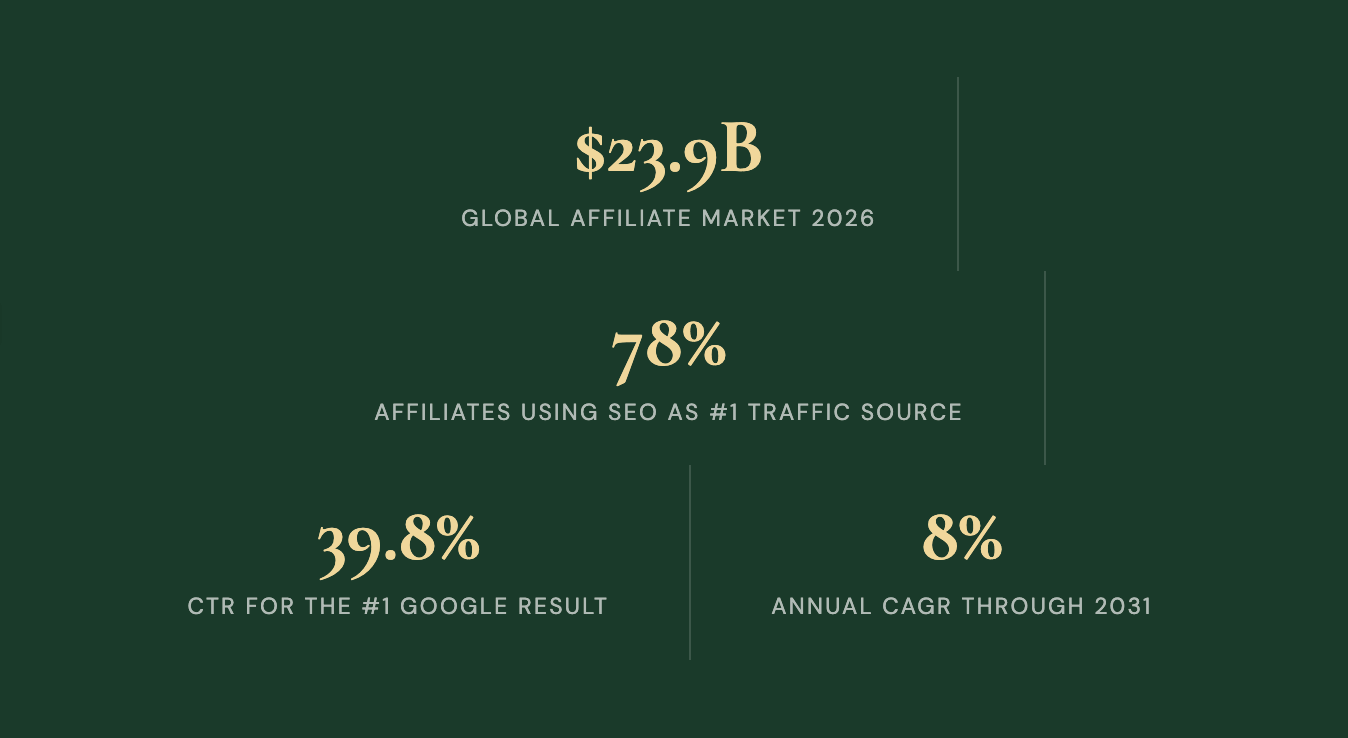
And consider this: the #1 Google result earns roughly 39.8% of all clicks, compared to 18.7% for position #2. A single position jump can more than double your traffic overnight.
“SEO affiliate marketing remains supreme. 78.3% of 2,000 affiliate marketers surveyed use SEO as their primary traffic source. ” AuthorityHacker Survey, 2025
The catch? Affiliate SEO has grown harder. Google’s algorithm now rewards experience, expertise, authority, and trust, not just keyword density. That’s why the secrets below go far beyond basic optimization.
Master High-Intent Keyword Research
Most beginners make one fatal mistake: they target keywords that are too broad. Writing about “the best laptops” puts you up against The Verge, CNET, and Best Buy’s entire SEO team. You cannot win that fight, and you don’t need to.
The real treasure in affiliate SEO lies in high-intent modifier keywords. These are search queries that signal a buyer is close to making a purchase decision.
“Best” Modifiers
Users want a curated shortlist. Create scannable comparison tables with clear persona-based recommendations.
“Review” Keywords
Users want risk reduction. Go deep on features, pricing, real use cases, and transparency about pros/cons.
“Vs.” Comparisons
Users want a clear tradeoff analysis. Use a consistent evaluation rubric and a fair, neutral tone.
“Alternatives” Pages
A sleeper win. Searchers have a specific objection to the market leader. Address it head-on to earn the click.
Pro Tip: Niche Down Ruthlessly
A site about “Electronics” will never rank. A site about “compact espresso machines for small apartments” can own its niche. Specificity builds topical authority, attracts targeted buyers, and faces far less competition.
When doing keyword research, lean on tools like Ahrefs, SEMrush, or Google’s own “People Also Ask” box.
Target a mix of low-competition long-tail keywords to build early wins, then graduate to higher-volume terms as your domain authority grows.
Build Topical Authority with Content Clusters
Google no longer rewards single, isolated articles. It rewards topical depth sites that comprehensively cover a subject from every angle.
This is the content cluster strategy, and it’s one of the most powerful SEO secrets for affiliate marketers.
Here’s how it works.
Choose a Pillar Topic
This is a broad, high-value subject in your niche (e.g., “home espresso machines”).
Create a Pillar Page
A comprehensive, authoritative guide that covers the topic at a high level and links to all cluster content below.
Produce Cluster Articles
Write in-depth sub-articles targeting specific angles: “best espresso machines under $200,” “how to descale an espresso machine,” “manual vs. automatic espresso machines,” etc.
Interlink Everything
Link cluster articles back to the pillar and to each other. Internal links are trust signals. Google follows them to understand your site’s structure and authority.
This architecture tells Google: “This site truly owns this subject.” The result is stronger rankings across the entire cluster, not just for a single article.
Turn E-E-A-T Into Your Unfair Advantage
E-E-A-T stands for Experience, Expertise, Authoritativeness, and Trustworthiness. Since Google’s 2024 algorithm updates, it has become the single biggest differentiator between affiliate sites that rank and those that don’t. Sites hit hardest by recent updates almost universally lacked E-E-A-T signals.
Experience
Show real proof you’ve used the product. Your own photos, videos, and screenshots, not stock images. Write “I tested this for 30 days,” not “users report.”
Expertise
Make your credentials clear. Display author bios with relevant qualifications. If you’re a certified nutritionist reviewing supplements, say so prominently.
Authoritativeness
Earn mentions and backlinks from respected sites in your niche. Be cited by others as a source of information.
Trustworthiness
Always disclose affiliate relationships. Use HTTPS. Display clear contact information. Earn and showcase user reviews.
The goal is to turn ‘affiliate’ into ‘editorial.’ That’s where trust and rankings converge.
Technical SEO: The Silent Ranking Killer
You can write the best affiliate review on the internet, but if your site loads slowly or breaks on mobile, Google will quietly demote you. Technical SEO is the unsexy foundation that everything else rests on.
Core Web Vitals
Google’s Core Web Vitals, measuring loading speed, interactivity, and visual stability, are direct ranking factors. Prioritize these above nearly everything else in your technical stack.
Mobile-First Optimization
Over half of all web traffic is mobile. Google indexes the mobile version of your site first. This means your affiliate CTAs, comparison tables, and product images must all be optimized for smaller screens with thumb-friendly tap targets.
Voice Search Readiness
An estimated 40 million Americans use voice search for shopping decisions. Voice queries are longer and more conversational.
Structure your content to directly answer questions like “What is the best espresso machine for under $300?” and you’ll capture this growing segment.
⚡ Speed Checklist
Compress all images, enable browser caching, use a CDN, minimize JavaScript, and choose a performance-optimized hosting provider. A page that takes 5+ seconds to load loses the visitor before they ever see your affiliate link.
Build Links the Right Way
Backlinks remain one of Google’s most powerful ranking signals. But the era of buying bulk links from sketchy directories is not just dead; it’s dangerous. Here’s how the pros earn quality links in 2026.
Create link-worthy assets
Original data, industry surveys, comprehensive guides, and free tools attract natural backlinks from other publishers.
Strategic guest posting
Write genuinely helpful articles for reputable sites in adjacent niches. The link is the byproduct, not the goal.
HARO / media outreach
Respond to journalist queries as an expert source. A single feature in a major publication can send your domain authority soaring.
Interlink internally
Don’t overlook your own site’s link power. Regularly link from high-authority pages to newer content you want to rank.
Community presence
Authentic participation on Reddit, Quora, and niche forums builds brand signals that increasingly feed into Google’s evaluation of authority.
Optimize for Answer Engines, Not Just Search Engines
In 2026, search is no longer just about ranking web pages. AI-powered systems, including Google’s AI Overviews and tools like ChatGPT, now answer queries directly, often without a click. This has created a new discipline called Answer Engine Optimization (AEO).
To surface in AI-generated answers.
- Structure content with clear headings and concise answers directly beneath them.
- Use FAQ sections (like the one below) targeting common questions in your niche.
- Implement schema markup: FAQ schema, HowTo schema, and Product Review schema all help AI systems parse and cite your content.
- Write with conversational clarity. AI systems prefer content written for humans, not algorithms.
- Build presence on platforms like YouTube and Reddit, as AI tools increasingly cite multi-platform sources.
🤖 The AI Search Reality
AI agents are now browsing, comparing products, and initiating transactions on behalf of users. Your site must be structured so that AI systems can easily extract and cite your content, or you risk being invisible to a growing portion of search behavior.
The Content Refresh Cycle
Here’s a secret most affiliate marketers ignore: your existing content is your most underutilized asset. Google rewards freshness.
An article updated with new pricing, new product options, and current data will frequently outrank a newer competitor who published a similar piece for the first time.
Build a quarterly content audit into your workflow. Look for:
- Outdated product recommendations or pricing information
- Missing new competitors or product releases in comparison articles
- Opportunities to add new FAQs, data points, or expert quotes
- Internal linking gaps to the new cluster content you’ve published
- The pages that dropped in rank need refreshing most urgently
A disciplined refresh cycle turns your archive into a compounding asset. Most sites begin ranking low-competition keywords within 3–6 months; with regular updates, those rankings hold and grow for years.
Common Mistakes That Kill Affiliate SEO
Monetizing too early
Building trust with your audience before adding affiliate links leads to higher long-term conversion rates.
Keyword stuffing
Google’s AI understands context. Write for humans first; natural keyword usage follows naturally.
Thin content
A 300-word “review” of a $500 product convinces no one and ranks nowhere. Go deep.
Ignoring analytics
Track organic traffic, click-through rates, and conversion paths. Without data, you’re navigating blind.
Skipping the disclosure
FTC guidelines require affiliate disclosure. A short notice at the top of every relevant post keeps you legal and builds trust.
Relying solely on Google
Diversify your digital presence across YouTube, email, and social to weather algorithm changes.
FAQ: SEO Secrets for Winning in Affiliate Marketing
What is the most important SEO secret for affiliate marketing?
The single biggest secret is treating your affiliate site as a trust-and-authority asset first, and a keyword machine second.
Ranking sustainably requires genuine E-E-A-T signals, topical authority through content clusters, and real product experience.
Affiliates who build credibility compound their results over time; those chasing quick SEO tricks get penalized.
How long does SEO take to work for affiliate marketing?
Most sites begin ranking for low-competition keywords within 3–6 months and competitive terms within 9–12 months, provided you’re publishing consistently, building quality links, and keeping your technical SEO clean. Regular content updates accelerate and sustain rankings over time.
Do I need a website to do affiliate SEO?
Not strictly creators on YouTube, TikTok, and Instagram build successful affiliate businesses. But a website gives you far greater SEO longevity, control over your content, and independence from platform algorithm changes. It’s still the recommended home base for a serious affiliate operation.
What tools do affiliate marketers use for SEO?
The three most relied-upon tools in 2026 are Ahrefs (for backlink analysis, keyword research, and competitor tracking), SEMrush (for site audits, organic research, and paid data), and SurferSEO (for on-page content optimization). Together, they cover keyword discovery, technical auditing, and content grading.
How do I disclose affiliate links properly?
Add a short, clear notice near the top of every article containing affiliate links: “This article contains affiliate links.
If you purchase through them, I may earn a commission at no extra cost to you.” This meets FTC requirements, builds reader trust, and keeps your site compliant.