I want to show you something most beginners completely overcomplicate.
When I first started in affiliate marketing back around 2012, when I was still in university, I thought a “funnel” meant you needed a huge budget, a complicated tech stack, and months of setup time. So I paralyzed myself. I read about funnels endlessly and built nothing.
That was a mistake I don’t want you to repeat.
The truth is, a simple funnel that actually converts can be built in a weekend. I know because I’ve built them, and I continue to build and refine them today alongside my engineering career. The fundamentals are always the same: get traffic, capture emails, build trust, and make an offer.
This guide walks you through exactly how to do that, step by step, without the hype.
What Is a Sales Funnel (And Why Should You Care)?
A sales funnel is the path a stranger takes to become a buyer.
Think about it from a systems perspective, which, as an engineer-turned-content-creator, I always do. You have an input (traffic), a series of processes (content, opt-in, email sequence), and an output (a sale or affiliate commission). If any stage in the system breaks down, the whole thing stops converting.
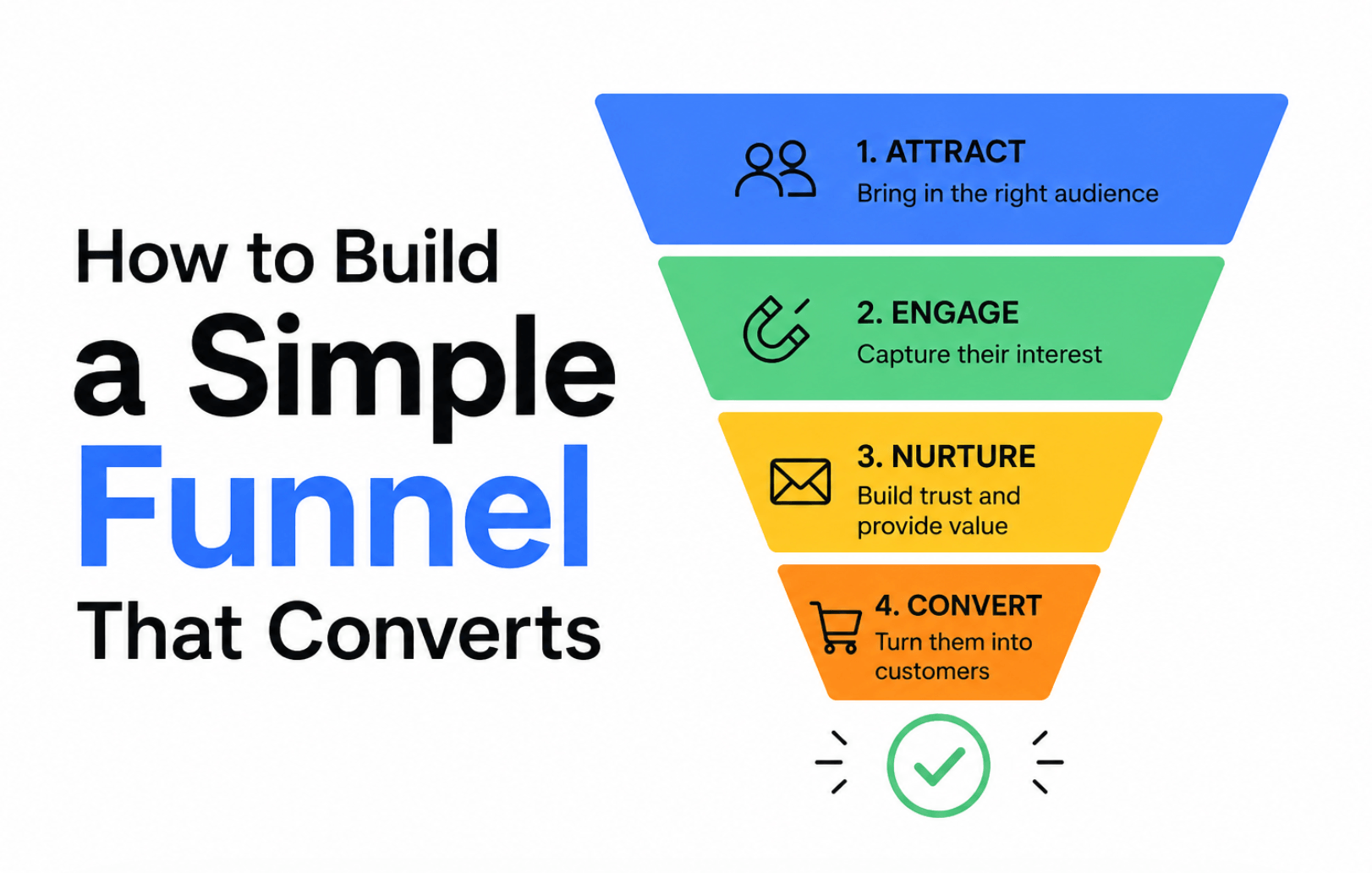
The classic funnel has four stages.
| Funnel Stage | Goal | Example Tool |
| Awareness | Get traffic to your content | Google SEO / Pinterest |
| Interest | Capture email with lead magnet | ConvertKit / Kit |
| Decision | Nurture with email sequence | Email automation |
| Action | Convert to paid offer | Gumroad / Sales page |
Most people only focus on the first stage, getting traffic. They write blog posts, pin on Pinterest, and post on social media, and then they wonder why they’re not making money. It’s because traffic without a funnel is just… noise.
Your funnel is what turns that noise into revenue.
5 Types of Marketing Funnels (And Which One to Start With)
Before you build anything, you need to know which type of funnel fits where you are right now. Here’s a quick breakdown.
| Funnel Type | Best For | Complexity |
| Lead Magnet Funnel | Email list building | Low |
| Tripwire Funnel | First-time buyers | Medium |
| Webinar Funnel | High-ticket offers | High |
| Self-Liquidating Offer | Paid traffic campaigns | Medium-High |
| Product Launch Funnel | Digital product launches | High |
My recommendation for beginners: start with the lead magnet funnel. It’s the lowest barrier to entry, it works with organic traffic, and it does the single most important thing for a new affiliate marketer: generate leads. It builds your email list.
Everything else can come later. Build the asset first.
How to Build a Simple Funnel That Converts: Step-by-Step
Here’s the exact framework I use and teach. Five steps, no fluff.
Step 1: Define Your Ideal Visitor (And What They Actually Want)
Before you write a single word or set up any tool, you need to answer one question: Who is this funnel for?
Not a vague answer like “people interested in making money online.” I mean a specific person with a specific problem. For example:
- A 9-to-5 employee who wants to earn a side income with affiliate marketing but has no idea where to start
- A stay-at-home parent who wants to monetize their blog traffic with digital products
- A freelancer looking to create passive income streams so they’re not trading time for money indefinitely
The more specific you are about who you’re talking to, the better your funnel will convert. Every message, every subject line, every landing page headline should speak directly to that person’s pain point.
Pro tip: Go look at Amazon reviews, Reddit threads, and Quora questions in your niche. The language people use to describe their problems is exactly what you should use in your funnel copy.
Step 2: Create a Lead Magnet That Solves One Specific Problem
Your lead magnet is the hook. It’s what you offer in exchange for someone’s email address, and it needs to be genuinely valuable.
The biggest mistake I see beginners make here is creating something too broad. A PDF titled “Make Money Online Guide” is not a lead magnet. It’s a vague promise. Nobody signs up for vague promises.
A strong lead magnet is
- Specifically, it solves one well-defined problem
- Fast to consume, a checklist, template, or short guide works better than a 50-page e-book.
- Immediately actionable, the person should be able to use it today
- Closely related to your paid offer, so the transition from freebie to sale feels natural
Examples of high-converting lead magnets.
- “The 5-Step Checklist to Set Up Your First Affiliate Blog in a Weekend”
- “7 Email Subject Lines That Get Opens (Swipe File).”
- “My Exact Tool Stack for Running a 6-Figure Affiliate Site”
See how specific those are? Each one speaks to a real frustration and promises a concrete outcome. That’s what gets opt-ins.
Step 3: Build a Simple Landing Page (You Don’t Need a Website)
This is where a lot of people stall out. They think they need a full website, a logo, and a professionally designed landing page before they can start.
You don’t.
Your landing page has one job: convert visitors into email subscribers. It should have:
- A headline that speaks directly to the problem your lead magnet solves
- Two to three bullet points explaining what they’ll get
- An opt-in form (name and email)
- A single call to action button (“Send Me the Checklist,” “Get Instant Access,” etc.)
That’s it. No navigation menu. No blog sidebar. No social media links. Those are all exits from your funnel.
For tools, I use Kit (formerly ConvertKit) because it includes a landing page builder, handles email automation, and keeps everything in one place. You can get started for free, and it scales well as your list grows.
Step 4: Write a Welcome Email Sequence That Builds Trust
Here’s the thing most people get wrong about email marketing: they think the goal of an email sequence is to sell.
It’s not. At least not right away.
The goal of your first few emails is to establish trust, demonstrate value, and position yourself as someone worth listening to. The selling comes after that foundation is in place.
Here’s a simple 4-email welcome sequence structure that works
Email 1: Deliver + Welcome
Send the lead magnet, introduce yourself briefly, and tell them what to expect from being on your list.
Email 2: Your Story
Share a relevant piece of your background that builds credibility. Be real. People connect with real stories, not polished bios.
Email 3: Your Best Content
Send them to your most helpful blog post or resource. This is pure value, no pitch.
Email 4: Soft Introduction to Your Offer
Now you can introduce your affiliate product or digital offer, but frame it as a solution to the problem you’ve been discussing, not as a sales pitch.
Spacing matters too. Send these over 5 to 7 days so you’re not overwhelming people. The goal is to show up consistently in their inbox and become a familiar, trusted voice before you ask for anything.
Step 5: Drive Targeted Traffic to Your Landing Page
With your funnel set up, now you need people to actually see it. This is where most guides spend all their time, but notice how I’ve put it last. You build the system first, then you send traffic to it. Not the other way around.
The best free traffic sources for a new funnel:
SEO Blog Content
Write articles targeting keywords your ideal visitor is already searching for. Each article should naturally lead readers to your lead magnet opt-in page.
Especially powerful for lifestyle, finance, and “how-to” niches. Create pins that link directly to your landing page or to blog posts that lead to it.
YouTube
If you’re comfortable on camera, a single well-optimized video can drive consistent traffic to your funnel for years.
Email Referrals
Once you have subscribers, encourage them to share. A simple PS line in your emails: “Know someone who’d find this useful? Forward this to them” works better than you’d think.
My personal focus is SEO content paired with Pinterest for distribution. It takes time to ramp up, but the traffic is compounding and doesn’t disappear when you stop paying for ads. That matters a lot when you’re building alongside a full-time career.
The Minimal Tool Stack You Actually Need
I’m going to be direct here: you don’t need ClickFunnels, Kartra, or any expensive all-in-one platform to build a converting funnel when you’re starting. Those tools have their place, but they’re not where you should be spending money before you’ve validated your offer.
Here’s what I actually use
Kit (ConvertKit): Landing pages, email automation, sequences. Handles the entire middle of your funnel.
WordPress + WPX Hosting: For my blog content, which feeds organic traffic into the funnel.
Rank Math: an SEO plugin that helps me make sure every article is optimized before publishing.
Gumroad: For selling digital products directly. Simple, no setup fees, and it handles everything from payment processing to delivery.
Canva Pro: For creating lead magnet PDFs and Pinterest graphics.
Total monthly cost when starting: under $50. Possibly under $30 if you’re on Kit’s free plan and using a basic hosting tier. There is no excuse not to start.
Common Funnel Mistakes That Kill Conversions
I’ve made most of these myself, so I’m not judging, just flagging them so you can avoid them.
Driving cold traffic to a sales page
People don’t buy from strangers. Always build the email relationship first.
Creating a lead magnet that’s unrelated to your offer
If your lead magnet is about productivity and your offer is an affiliate marketing course, there’s a disconnect. Keep them aligned.
Sending only promotional emails
Your subscribers will tune you out or unsubscribe. The rule of thumb: give value in 80% of emails, pitch in 20%.
Building a complicated funnel before validating the offer
Start with the simplest version. A landing page, a 4-email sequence, and one clear offer. Optimize after you see real data.
Ignoring your metrics
You need to know your opt-in rate, open rate, click rate, and conversion rate. If you don’t measure it, you can’t improve it.
What Does ‘Converts’ Actually Mean? Benchmarks to Know
The word “converts” gets thrown around a lot without context. Here are realistic benchmarks to know if your funnel is performing:
- Landing page opt-in rate: 20–40% is solid for a targeted traffic source. Below 15% means your headline or offer needs work.
- Welcome email open rate: 40–60% for a fresh subscriber is normal. This will drop over time, which is fine.
- Click-through rate on emails: 2–5% on a general broadcast; 5–10% on a well-segmented, high-trust list.
- Sales conversion on a digital product (cold audience): 1–3% of email list. Higher if you’ve warmed them up well.
These aren’t gospel; they vary by niche, offer price, and audience quality. But they give you a baseline so you’re not flying blind.
Frequently Asked Questions
Do I need a website to build a funnel?
No. Many email service providers like Kit include landing page builders. You can have a functioning funnel without a website at all.
That said, a blog gives you a long-term organic traffic engine, which is why I recommend building one eventually, but it doesn’t have to come first.
How long does it take for a funnel to start making money?
It depends entirely on your traffic. A funnel with no traffic earns nothing. If you’re starting from zero with organic SEO, expect 3 to 6 months before you see meaningful results.
If you have an existing audience or you’re running paid traffic, it can be much faster. The funnel itself is not the bottleneck; traffic is.
What’s the difference between a funnel and a landing page?
A landing page is one component inside a funnel. The funnel is the entire journey from the moment someone finds you to the moment they buy (or don’t). Your landing page is just the step where they opt in.
Can I build a funnel for affiliate marketing?
Absolutely, that’s actually one of the best use cases. Instead of sending cold traffic directly to an affiliate link (which rarely converts well), you send them to a landing page, capture their email, build trust through your sequence, and then recommend the affiliate product naturally within that context. Your commissions will be higher because you’re promoting to people who already trust you.
How many emails should be in my welcome sequence?
Start with 4 to 7 emails. That’s enough to build trust and make an initial offer without overwhelming your new subscriber. You can always expand the sequence later, but get the basics working first.
Do I need paid ads to make a funnel work?
No. I’ve built funnels entirely on free organic traffic, SEO, and Pinterest specifically. Paid ads can accelerate things, but they also add a layer of complexity and cost.
For beginners, I always recommend validating your funnel with free traffic before spending money on ads. If it doesn’t convert organically, throwing money at it won’t fix the underlying problem.
Final Thoughts: Build Simple, Then Optimize
If there’s one thing I want you to take away from this guide, it’s this: done is better than perfect.
I spent years reading about funnels, watching webinars, and collecting tools without actually building anything.
When I finally sat down and built a simple 4-step system, traffic, opt-in, email sequence, and offer. Everything changed. Not because the funnel was sophisticated. Because it existed.
You don’t need a complicated system. You need a system that works. Start with the basics outlined here, get real data, and optimize from there.
The funnel that converts is always the one you actually build.
Ready to take the next step? Check out my article on how to build an email list from scratch; it goes deeper on the opt-in strategy that feeds this entire funnel.