Artificial intelligence has created hundreds of new ways to earn money online. It has also created a new problem: too many options.
One person tells you to sell AI-generated ebooks. Another recommends faceless YouTube channels, automated agencies, prompt packs, chatbots, or AI affiliate sites. Before long, you have opened a dozen tools, bought three courses, and earned nothing.
I do not believe the answer is another list of 50 AI side hustles. What beginners need is a clear path from learning to selling and from selling once to building something repeatable.
That is the purpose of this AI side hustle roadmap.
I am approaching it as someone with a full-time job, professional experience, family responsibilities, and several online projects. I cannot spend every day chasing a new trend.
My side hustle needs to fit around real life, use skills I already have, and eventually become a digital asset that can generate income without depending entirely on my time.
This is not a promise that you will make a certain amount in 30, 60, or 90 days. Results depend on your skills, offer, market, effort, and ability to find customers.
It is the practical route I would follow to move from zero to the first sale and then toward consistent income.
The simple AI side hustle model
My roadmap is based on a straightforward idea:
Use AI to help a specific group of people achieve a valuable result, then turn the work into a repeatable service or digital asset.
AI is the leverage, not the business.
Customers rarely want “AI.” They want more leads, better content, saved time, clearer documents, faster research, attractive graphics, or fewer repetitive tasks. The opportunity is to connect an AI-assisted process to one of those outcomes.
The model has five parts:
- Choose one audience.
- Solve one painful problem.
- Package one simple offer.
- Find real buyers.
- Turn successful work into a system or asset.
This focus matters. A narrow offer is easier to explain, sell, deliver, and improve than a vague promise such as “I provide AI solutions.”
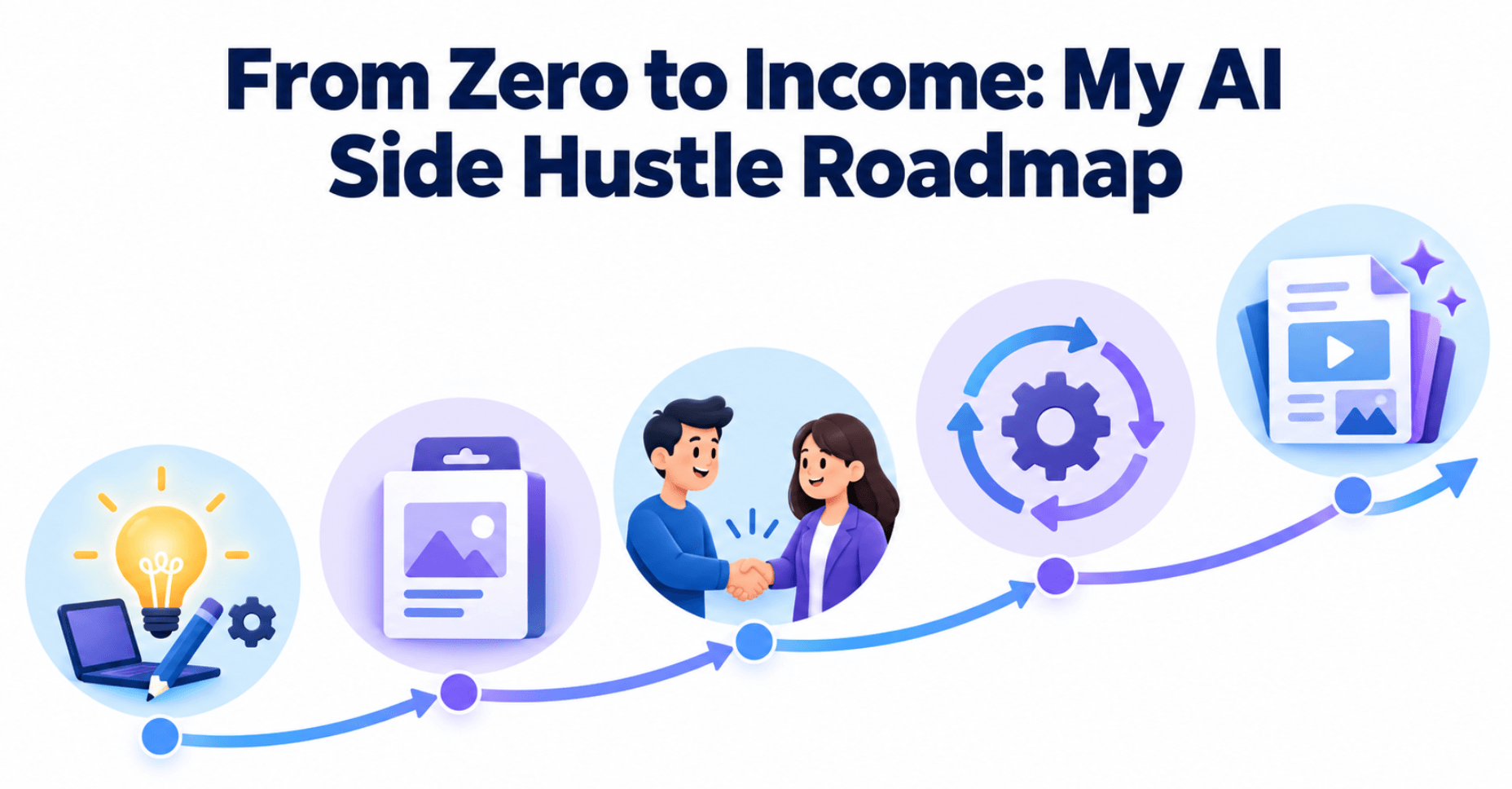
From Zero to Income: My AI Side Hustle Roadmap
Phase 1: Build the foundation (Days 1–7)
The first week is not about building a complicated website or mastering every AI tool. It is about choosing a sensible starting point.
Start with skills you already have
I would begin by listing three things
- Tasks I can already perform reasonably well
- Industries or audiences I understand
- Problems people already pay to solve
For example, my experience includes technical support, industrial automation, blogging, SEO content, affiliate marketing, and creating training material. AI can accelerate those skills, but it does not replace the underlying knowledge.
A beginner may have different assets: customer service experience, knowledge of a local business sector, competent writing, spreadsheet skills, video editing, teaching ability, or fluency in two languages. These are all useful starting points.
The best first AI side hustle often sits at the intersection of an existing skill and a repetitive, valuable task.
Choose one audience and one problem
“Small businesses” is too broad. “Independent real estate agents who struggle to publish consistent local content” is much clearer.
Other examples include
- Local contractors who need Google Business Profile posts
- Coaches who want to repurpose long videos into short social posts
- Online shops that need better product descriptions
- Technical companies that need understandable knowledge-base articles
- Job seekers who need help organizing résumés and interview preparation
Choose a problem that is frequent, noticeable, and connected to a result that the customer values.
Select a low-risk business model
There are three practical ways to start
| Model | Best for | Main advantage | Main limitation |
|---|---|---|---|
| AI-assisted service | Earning and learning quickly | Direct customer feedback | Initially tied to your time |
| Digital product | Packaging repeatable knowledge | Can sell repeatedly | Usually needs an audience or traffic |
| Content and affiliate marketing | Building a long-term asset | Compounding search and email traffic | Often slower to produce income |
My preference is to start with a small AI-assisted service. It can produce faster feedback than waiting for a blog or social account to grow.
Once I understand what customers want, I can convert parts of the service into templates, guides, training, affiliate content, or another scalable asset.
Phase 2: Create a minimum viable offer (Days 8–14)
The goal of week two is not perfection. It is to create the smallest version of an offer that someone can understand and buy.
Write a one-sentence offer
Use this formula:
I help [specific audience] achieve [specific result] by providing [defined deliverable] within [time frame].
For example:
I help independent consultants turn one recorded interview into four search-focused articles and twelve LinkedIn posts within seven days.
That is stronger than saying, “I offer AI content creation.” It defines the buyer, result, deliverables, and time frame.
Design a small starter package
My first package would include one clear outcome and a fixed scope. It might contain:
- One discovery questionnaire
- One defined deliverable
- One revision
- A clear delivery date
- A simple introductory price
I would avoid unlimited revisions, complex retainers, and promises about rankings, leads, or revenue. The first objective is to prove that I can deliver useful work consistently.
Build samples before chasing customers
If I have no clients, I can create two or three realistic samples for the audience I want to serve. I would label them as samples, not client work.
AI may help with research, outlines, drafts, variations, or formatting, but I would personally check every output.
Facts, brand voice, originality, and accuracy remain my responsibility. This is especially important in technical, financial, health, and legal topics.
Keep the tool stack small
A beginner does not need ten subscriptions. A basic stack may include
- One capable AI assistant
- Google Docs or Microsoft Word
- Canva or another simple design tool
- A spreadsheet or lightweight project tracker
- A payment method available in your country
Add specialized tools only when a paid project justifies them or when they remove a proven bottleneck.
Phase 3: Validate the offer with real people (Days 15–30)
An offer is not validated because it sounds appealing to me. It is validated when people respond, ask questions, request a sample, book a call, or pay.
Start with conversations, not automation
I would identify 30 to 50 potential buyers and study how they currently handle the problem. Then I would contact a small number each day with a personal message.
The message should be brief:
Hi [Name], I noticed [specific observation]. I help [type of business] achieve [specific outcome]. I put together a quick example showing how this approach could work for [their business]. Would you like me to send it?
The purpose is to begin a relevant conversation, not send hundreds of identical messages; personalization and genuine relevance matter more than volume.
Potential channels include
- Existing professional contacts
- Local business groups
- Relevant online communities
- Freelance marketplaces
- Direct email to carefully selected businesses
Always follow platform rules and applicable email laws. Avoid scraped lists, deceptive claims, and mass unsolicited messages.
Treat objections as market research
If people do not respond, I would still consider the idea. I would examine four variables
- Am I contacting the right audience?
- Is the problem important enough?
- Is the result easy to understand?
- Does my sample create trust?
Ten thoughtful conversations can teach more than weeks spent redesigning a logo.
Aim for a paid pilot
A paid pilot is better evidence than praise. I may use an introductory price because I am testing the process.
Still, I would avoid working for free unless the project provides a genuinely valuable case study, testimonial, or strategic relationship.
For the pilot, I would agree in writing on the scope, timeline, price, revision limit, and how the work may be used. After delivery, I would ask what was useful, what was missing, and what the customer would want next.
Phase 4: Earn and improve (Days 31–60)
Once I complete the first projects, the work changes. I am no longer guessing entirely. I now have delivery times, customer questions, objections, and quality feedback.
Document the workflow
For every project, I would record
- The information I need from the customer
- Research and fact-checking steps
- Prompts or instructions that consistently help
- Quality-control checks
- Delivery format
- Revision patterns
- Actual time spent
This becomes a standard operating procedure. It helps me deliver faster without allowing quality to decline.
Use AI where it is strongest
AI is useful for generating alternatives, organizing information, summarizing source material, creating first drafts, repurposing content, and handling structured repetitive work.
Human judgment is still essential for
- Choosing the right strategy
- Verifying facts and sources
- Understanding customer context
- Protecting confidential information
- Editing for clarity and brand voice
- Making ethical decisions
- Approving the final work
I would never paste sensitive client information into a tool without understanding its privacy terms and receiving any necessary permission.
Improve pricing with evidence
Instead of selecting a price based on social-media claims, I would calculate:
- Time required to sell and deliver
- Software and contractor costs
- Complexity and revision risk
- Value of the result to the buyer
- Comparable alternatives in the market
If demand rises and the result is strong, I can increase the price, narrow the package, or both. Consistent scope is often more important than offering more deliverables.
Collect proof honestly
With permission, I would capture a testimonial, before-and-after example, or short case study. Good proof describes the starting problem, what I delivered, and the practical improvement. It does not require exaggerated income claims.
Phase 5: Build repeatable income (Days 61–90)
By the third month, my priority would shift from proving the offer to building a reliable system.
Choose one acquisition channel
I would select the channel that produced the best conversations during validation and use it consistently.
That could mean sending five personalized outreach messages each weekday, publishing two useful LinkedIn posts per week, or creating search-focused articles that answer buyer questions.
Trying to master YouTube, Pinterest, SEO, email, LinkedIn, and X at the same time spreads limited energy too thin.
Introduce recurring value
One-off work can become more stable when the customer needs the result regularly. Examples include monthly content repurposing, weekly newsletter production, ongoing knowledge-base updates, or recurring automation maintenance.
The recurring offer should address a problem that arises repeatedly. It should not exist merely because I want predictable revenue.
Turn service knowledge into an asset
This is the part of the roadmap that matters most to me. Service work generates income and teaches me what the market buys. I can then use that knowledge to create assets such as
- Templates and checklists
- A focused ebook or mini-course
- A niche newsletter
- An SEO content site
- A lead magnet and email sequence
- A small software or automation tool
- Carefully selected affiliate recommendations
This process is how a side hustle can evolve from selling hours to owning systems, content, and intellectual property.
My realistic weekly schedule
I would rather follow a modest schedule for six months than an exhausting plan for six days. With approximately seven to ten hours per week, my schedule could look like this.
| Activity | Weekly time |
|---|---|
| Customer outreach and follow-up | 2.5 hours |
| Client delivery | 3 hours |
| Improving the process and samples | 1.5 hours |
| Publishing useful content | 1.5 hours |
| Reviewing results and planning | 30 minutes |
During the validation stage, I would spend more time speaking with potential customers. After sales begin, delivery and process improvement would receive more attention.
The numbers I would track
Revenue matters, but it is a delayed result. I would also track the actions that create it:
- Qualified prospects contacted
- Replies and conversations
- Proposals or offers sent
- Sales closed
- Average project value
- Hours spent per project
- Revision rate
- Repeat purchases
- Leads generated by content
These numbers show where the system is weak. If nobody replies, the problem may be targeting or messaging. If people reply but do not buy, the offer or trust level may need work. If customers buy but projects consume too much time, delivery needs to be simplified.
Mistakes I would avoid
Buying tools before finding a problem
Software feels like progress, but customers pay for outcomes. I would begin with the minimum stack and upgrade when revenue or workload creates a reason.
Changing ideas every week
No offer provides enough data if I abandon it after five messages. I would set a validation threshold, such as 30 meaningful contacts and at least ten real conversations before making a major decision.
Publishing unedited AI output
Generic, inaccurate content damages trust. Everything should be fact-checked, edited, and improved with firsthand experience or original insight.
Waiting for a perfect brand
A simple page or professional profile with an offer, samples, and a contact method is enough to begin. Branding can improve after I understand the market.
Confusing activity with traction
Creating prompts, watching tutorials, and redesigning a website may feel productive. Conversations, proposals, sales, delivery quality, and repeat business are stronger evidence of progress.
What “from zero to income” really means
The first income from an AI side hustle is not the finish line. It is proof that a real person values the result enough to pay for it.
My roadmap is intentionally simple.
- Days 1–7: Choose an audience, problem, and model.
- Days 8–14: Create a focused offer and credible samples.
- Days 15–30: Speak with potential buyers and sell a paid pilot.
- Days 31–60: Deliver well, collect feedback, and document the process.
- Days 61–90: Focus on one acquisition channel, pursue repeat business, and begin building an asset.
I may move faster or slower than this timeline. What matters is completing the stages in order. Learning without selling creates no market evidence.
Selling without delivering creates no trust. Delivering without documenting makes growth harder.
AI gives individuals access to capabilities that once required a larger team, but the fundamentals have not changed.
A sustainable side hustle still requires a useful offer, a reachable customer, reliable delivery, and patience.
My goal is not to chase every AI opportunity. It is to build one small, honest income system and then improve it until it becomes a durable digital asset.
Frequently asked questions
Can I start an AI side hustle with no experience?
Yes, but start with a narrow task and spend time learning the underlying skill. AI can shorten the learning and production process, but you still need to evaluate the output and deliver a result that is useful to the customer. Begin with small projects, samples, and a clearly limited scope.
What is the best AI side hustle for beginners?
For many beginners, an AI-assisted service is the most practical starting point because it requires little upfront investment and provides direct market feedback.
Good options depend on your current skills and may include content repurposing, research assistance, simple graphic production, administrative workflows, or specialized document creation.
How much money can an AI side hustle make?
There is no reliable universal figure. Income varies according to the offer, demand, pricing, sales ability, quality, available time, and competition.
Focus first on earning one legitimate sale, then measure whether the process can be repeated profitably.
Do I need to know how to code?
No. Many AI-assisted services and digital products require no programming. Coding can expand your options, especially for custom automations and software, but writing, research, design, sales, industry knowledge, and project management are also valuable.
How long does it take to earn your first income?
Some people may find a customer within weeks, while others need several months to develop their skills, offer, and audience.
A 90-day roadmap is a useful operating window, not an income guarantee. Consistent customer conversations usually provide faster feedback than building privately for months.
Should I disclose that I use AI?
Be transparent whenever a client, platform, contract, law, or professional standard requires it. Even when disclosure is not mandatory, never misrepresent how work was created or claim expertise you do not have. The final quality, accuracy, permissions, and confidentiality remain your responsibility.
Final thought
If you are starting from zero, choose one audience and one outcome today. Write a one-sentence offer, create one sample, and show it to one potential customer.
You do not need the complete business figured out before you begin. You need a useful first step and the discipline to learn from what happens next.
Next step: Read How to Start an AI Side Hustle With No Experience for a beginner-friendly setup guide, then explore AI Side Hustles in 2026: 15 Ways to Make Money. With AI, you can choose a model that fits your skills.